


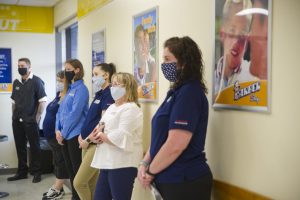
When the COVID-19 pandemic prompted the closure of civilian barber shops across the United States, Fort Hood Exchange barber concessionaire Melvin Kessler found himself in an industry beset by fear.
This fear, he reasoned, stemmed from a basic lack of preparedness: Barber shop employees, after all, aren’t required to receive any public health certification beyond the basic sanitation course taught in barber and cosmetology schools.
“The COVID-19 pandemic opened my eyes to see that my industry can be better and do better,” Kessler said. “If businesses and license holders were required to have public health training and regularly take recertification courses with updated content, then the amount of fear in our industry would be significantly reduced.”
Kessler wanted Fort Hood, where barbers continued serving Soldiers and families throughout the pandemic, to set the example. He reached out to the installation’s Department of Preventive Medicine about having his barbers take a public health certification course. Sgt. Natalie Seals of the 7417th Troop Medical Clinic and Capt. Vonessa Robinson, Chief of Environmental Health at the Carl R. Darnall Army Medical Center, offered to develop curriculum specifically tailored to Exchange barber shops.
Seals and Robinson administered the mandatory course to Exchange barbers on May 13, sharing best practices for mitigating the spread of bacteria and viruses. They also discussed the latest strategies from the Department of Defense, Centers for Disease Control, U.S. Public Health Service and World Health Organization on preventing transmission of COVID-19.
“We wanted to create a conversation,” Seals said. “I didn’t want to turn it into the type of training you would give to a military audience. I had to realize these are contractors and Exchange personnel. I wanted them be comfortable, but at the same time know these guidelines are imperative to keeping your customers safe.”
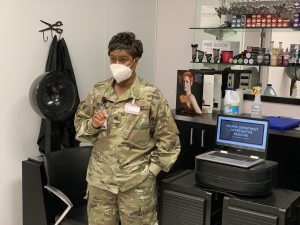
As an extra check and balance, Seals and Robinson provided the curriculum to Fort Hood public health inspectors for use in future barber shop inspections. Exchange services staff also received the training so they can ensure compliance when conducting their own inspections.
“Partnerships like this really do make a difference,” said Exchange Services Business Manager Jeanne Young. “We appreciate Preventive Medicine helping us keep our customers safe. They have a job to do, and if we do our job right, then everything is on the up-and-up.”
Kessler said the course’s biggest surprise was seeing how large of a role Preventive Medicine envisioned post barber shops playing in the fight against the coronavirus.
“We can help Public Health track any and all communicable diseases or viruses that someone may present symptoms of within our facilities,” he said. “In the event someone comes into a facility showing symptoms, we can provide the customer’s contact information to Public Health department and they can start investigating immediately.”
The concept has since spread to other Fort Hood Exchange facilities, with Seals and Robinson providing a similar course to stylists at the Paul Mitchell salon on May 20. Kessler, meanwhile, has put the course online so public health officials at about 30 other military installations can administer the training to employees at the rest of his Exchange barber shops.
“We are showing everyone that the Exchange and its concessionaires set the bar higher,” Kessler said. “We will always go above and beyond to serve those who serve while putting their health and safety first.”
Setting that bar higher would not have been possible, Kessler said, without the guidance provided by Seals, Robinson and Young.
“I was sailing a ship through a storm at night, and they were the co-captains who helped me find the way back to shore,” he said. “Without their essential support and partnership in this, I wouldn’t have been able to make my way back to land.”

Leave a Reply