
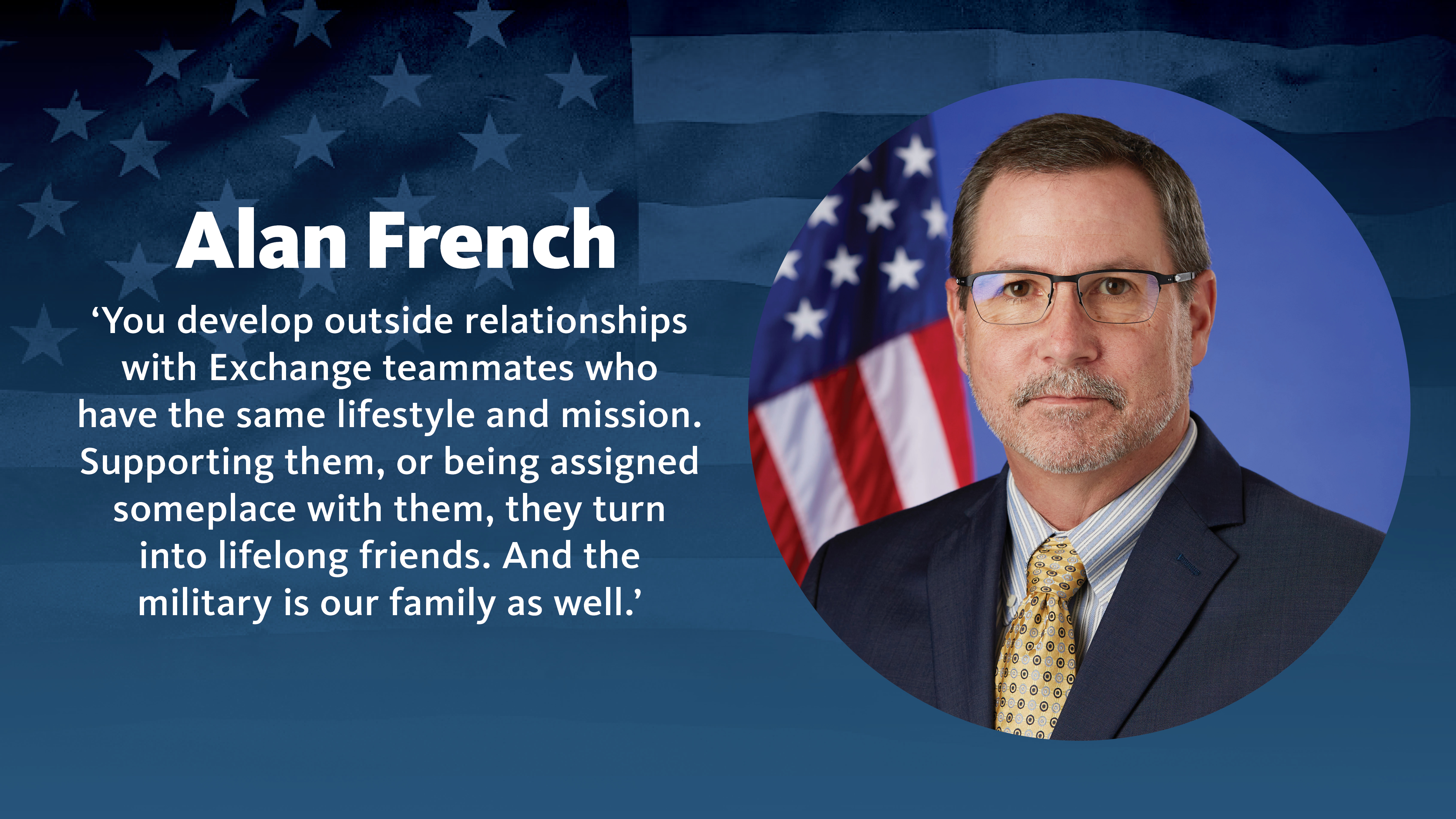

Even before he began a lengthy career in Exchange Logistics, Alan French heard all about the organization’s “We Go Where You Go” mission. His father, Jim, worked in Logistics for 27 years.
The younger French was about 12 when the family moved from Arlington, Texas, to Georgia, where Jim French managed the fashion warehouse. When a more permanent warehouse was established at HQ two years later, the family returned to Texas.
Alan French worked three summers at the Exchange as an intermittent associate while he was still in high school.
“But I couldn’t work for my dad,” French said. “So they put me in an office making the hang tags for clothing. The tags all used to be made at headquarters in a little room with big machines. I did that and stuffed tickets into envelopes. I had a lot of paper cuts!”
It was the start of a four-decade-plus journey that will conclude Jan. 1, when French will retire as Executive Vice President/Chief Logistics Officer for the Exchange.
Growing up with the Exchange
One of French’s grandfathers served in World War II; the other served in the Korean War. An uncle served in the Vietnam War. But his earliest connection to the Exchange was a civilian cousin
“My cousin, who was closer to my mother’s age, married someone who joined the Army,” he said. “We used to take trips to Fort Rucker, where they were stationed. I remember going to the Fort Rucker PX when I was a kid, before my dad started working for the Exchange.”
When he was about 20, French was trying to find full-time employment when his father suggested that he apply at the new Newport News Distribution Center, now known as the Dan Daniel Distribution Center. He did, and it wasn’t long before he began to sense a career path.
“I walked into this huge building, unbelievably big,” French said. “It was crowded and busy. There were full crews in receiving and lots of freight, and we were trying to fill up the building so we could start shipping. I was amazed by all that. The opportunities for overtime were unlimited, so I was able to make a little bit of money as a young guy.”
He had the first of several epiphanies.
“I was unloading trailers in receiving and it didn’t take me long to realize, ‘Hey, I’ve got a boss over there, and she’s telling other people what to do and solving problems,’” he said. “I thought, ‘That’s what I want to do.’ So after I was there six months, I got a foreman position.”
A little more than a year after Dan Daniel held its grand opening in 1988, the Waco Distribution Center opened.
“They put these Waco managers with me to work in the receiving department,” French said. “They did their training and left, and I continued doing my job. Then one day I got a phone call: ‘Hey, we remembered you said you were from Texas. Are you interested in coming to Waco? We can bring you on here as a foreman.’
“I was born and raised in Texas. I said, ‘Yeah, let’s do this.’”
Waco and Beyond
The Waco DC was so new when French arrived that one of his crew’s duties was assembling furniture for the DC’s offices. About a year after the DC opened, Operation Desert Shield started and, although he didn’t deploy, it gave him a clearer perspective about the Exchange mission.
“Operation Desert Shield was my first big insight into what we do for the military,” French said. “There were suddenly big meetings: ‘The military’s prepping, we need truckloads of merchandise and we need to load it in containers and ship it Saudi Arabia.’ Desert Shield and Desert Storm were relatively short-lived, so the retrograde merchandise came back into Waco. Seeing cases of Gatorade covered with sand, you’d think, ‘Whoa—this is different.’”
French worked his way up in Waco, becoming an inventory management specialist. It was officially an HQ job, but he remained in Waco, acting as a liaison between the DC and buyers, addressing inventory issues. He did that for about three years, then the position was eliminated and he went back to working directly for the DC as storage manager. After nine years at Waco, he made a bigger move—to the Giessen DC in Germany.
Germany was French’s favorite assignment. “I suddenly became the focal point for every general manager in Europe,” French said.
French served as transportation manager for Europe, which had its challenges because of varying laws and geography, not just in Europe but in Southwest Asia.
“You’d have imports and exports, a private fleet, air freight and you’re shipping to places like the Sinai Desert, to places in Kuwait left over from Desert Storm, to Saudi Arabia,” French said. “While I was in Europe, the peacekeeping mission in the Balkans kicked off. There were a lot of contingencies for locations in Bosnia and Kosovo that you didn’t have to deal in the U.S.”
In Europe, French says, his appreciation for the mission deepened even further.
“It was where I really began to understand our customer,” French said. “I worked on the installation and got to know the families on base. I was shopping at the BX and at the commissary as well. I not only worked for the Exchange, I became one of our customers.”
And he benefited from the Exchange providing the best tastes and comforts of home.
“I remember driving from Giessen to Wurzburg when AAFES opened the first Taco Bell in Europe,” he added (Wurzburg is about 110 miles from Giessen). “We drove there and stood in line for two hours just to get Taco Bell.”
A PCS to HQ
In August 2001, French received orders to return to the States. During the first week of September, he arrived in Dallas for an HQ-based logistics position. Less than a week later, the 9/11 attacks happened.
“That upended anything I was learning about my job,” French said. “Suddenly there were different tasks and duties, and we were arranging for mobile field exchanges in New York and Washington and the whole world stopped for a little while.”
Less than a month into his new role as a logistics analyst, French traveled to California, where he spent October at the West Coast DC in French Camp, California, to help open yet another new distribution center.
“The expectation for most people on the Logistics team at the time was three to five years in headquarters, then they’d go back out and become distribution center managers and transportation managers,” French said, then added jokingly: “I guess I never got enough staff experience, because I’ve never left HQ.”
French may have been based in Dallas, but he saw the world. Operation Enduring Freedom started weeks after he came to HQ, and Operation Iraq Freedom launched a couple of years later.
“I was working on the transportation side,” French said. “I was coordinating with the military on staff at headquarters and the military that were sent downrange. We even had some military associates in Logistics that were sent to Kuwait. We were flying to Southwest Asia, we were on the phone with Army G-4 at the Pentagon talking about how we needed help to get our merchandise prioritized and moved.
“As soon as there are boots on the ground, they’re looking for their Exchange,” he added. “We’re constantly reminding people about that, so when troops are deployed, they have more than just MREs. The troops have become accustomed to seeing an Exchange.”
The Executive Era
In 2013, Logistics SVP/Chief Logistics Officer Karen Stack, asked French if he would like to fill a vice-president vacancy and he agreed. He became VP of logistics operations, the first in a series of VP roles until he was named supply chain SVP in 2020. When Stack retired at the end of 2023 as an EVP and CLO, French moved into the role. He says he owes a lot to her.
“She is absolutely the most caring person,” he said. “I feel like I’ve always cared about the associates, and I hope more than anything that as I leave here, people are the legacy I leave. She taught me a lot about that.”
French’s journey still comes as a bit of a surprise to him.
“My first couple of years in college, I studied horticulture and landscape management,” he said. “Then I switched to business. I didn’t think any of that would put me in the middle of a warehouse loading trucks, but that’s what I ended up doing. I can now look at a warehouse and understand the concepts being used and see what’s working and what’s not.
“Since I’ve been here, we’ve gone from using paper materials to run warehouses to electronics scanning, finger scanning, no-touch scanning and robotics,” he continued. “Now we’re using drones. I’ve watched an evolution that’s unbelievable.”
Retirement plans
French has one more military connection: his wife, Dianna, an Army Veteran who worked in the Logistics and Services and Food Directorates until she retired in 2023.
“She spent four years in the Army, at Fort Carson and in Korea,” he said. “When she was in Korea, she relied on the Exchange. This summer, I took my last trip to the Pacific and she met me in Korea. I got to see where she used to be stationed and she got to see how much Camp Humphreys has ballooned since the mid-‘90s when she was there.”
After French retires, they plan to move to the Texas Hill Country west of Austin.
His retirement will end a long run for his family working at the Exchange—but the Exchange will always be his family.
“I’m an AAFES brat,” he said. “My dad helped me see the light and I took a job at the Exchange that turned out to be a career. You develop outside relationships with Exchange teammates who have the same lifestyle and mission. Supporting them, or being assigned someplace with them, they turn into lifelong friends.
“And the military is our family as well. And we want them to know that they’re part of our family. It’s incorporated into the mission. As our CEO Tom Shull says, the Exchange is ‘family serving family.’”
If you’d like to wish Alan French well on his retirement journey, please comment on this story.



Leave a Reply