


On Veterans Day, Exchanges worldwide honored those who have served by presenting them with a special challenge coin. The coins, which feature an eagle on one side and the emblems for all six military branches on the other, are a sign of appreciation for our Veterans’ sacrifice, and will be available at all military Exchanges.
This is part of the challenge-coin culture in the military and at the Exchange, where Director/CEO Tom Shull, a Vietnam War-era Army Veteran himself, has presented his office’s coin to hundreds of associates to honor them for stellar work. Other senior Exchange leaders also have challenge coins that they present to associates who go above and beyond to serve those who serve.
But how did this tradition start? The answers vary.
“Some say that the challenge coin goes all the way back to ancient Roman times,” said Chief Master Sgt. Rich Martinez, Exchange senior enlisted advisor. “The leaders would give soldiers a round coin to commemorate bravery or show appreciation for something the soldiers did.”
Martinez—whose office at Exchange headquarters includes a coffee table with an array of the coins— added that there is documented evidence of the practice being revived during World War I. “They might have a unit’s insignia on them or something to that effect,” he said. “In World War II, coins still were commemorative, but they also became something that you traded with others as a thank-you.”
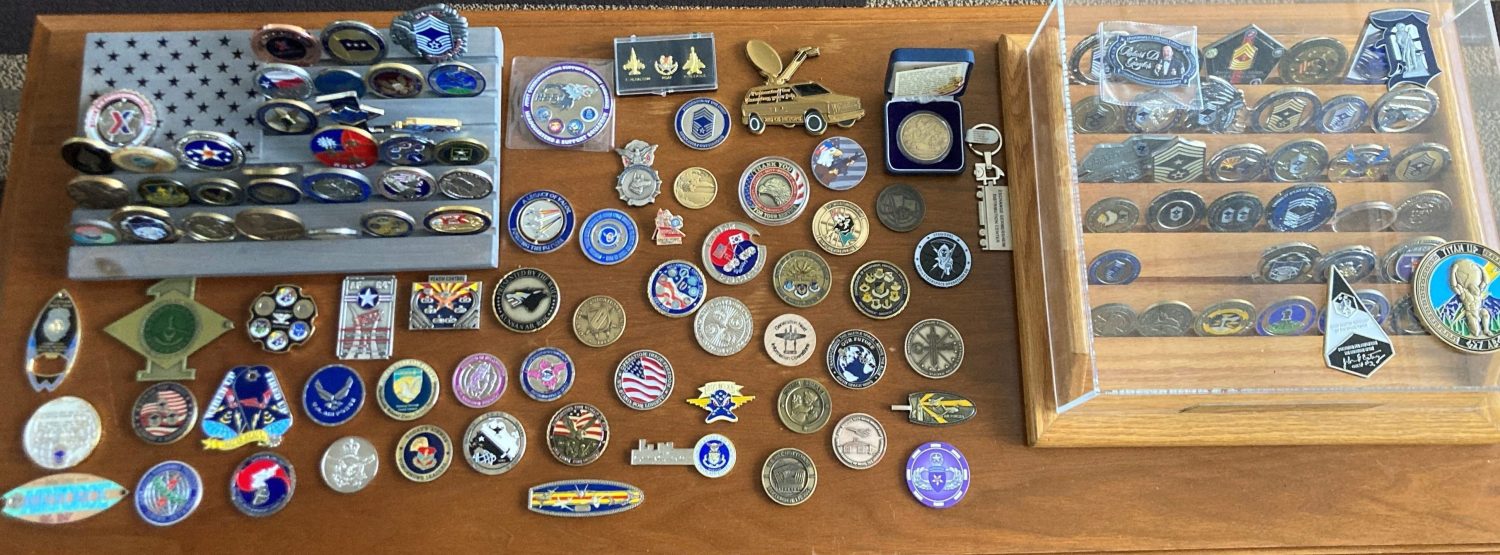
Exchange Senior Enlisted Advisor Chief Master Sgt. Rich Martinez has a coffee table with a display of challenge coins in his office at Exchange headquarters.
According to a 2017 Department of Defense article, a common belief is that a wealthy lieutenant who volunteered to serve in World War I wanted to give each member of his unit a memento, so he ordered several coin-size bronze medallions. He was shot down over Germany and captured by a German patrol, who took all items in his possession—except the leather pouch he kept the medallions in.
He eventually managed to find some civilian clothing and escape, but when he entered a French outpost, the French soldiers assumed he was an enemy. Remembering the pouch, he showed the soldiers one of the coins, which had his unit’s insignia. One of the French soldiers recognized the insignia, so the lieutenant avoided execution. After that, it became a tradition for all service members to carry a coin identifying their unit.
Yet another version traces the practice back to the Boer War in the late 19th/early 20th century. According to that version, British officers were the only ones authorized to receive medals during the war—even if the medal was for an enlisted person who did a good job.
“The regimental sergeant major would sneak into the officer’s tent and cut the medal from the ribbon,” Eighth Master Chief Petty Officer of the Coast Guard Vincent W. Patton, who had researched coin history while attending the U.S. Army Sergeants Major Academy, said in a 2006 Third U.S, Army Public Affairs article. “He would then call an all hands to formally shake the hand of the exceptional soldier, and would ‘palm the medal’ in the soldier’s hand without anyone knowing,” Patton said.
Patton, who got his information from a 1969 issue of Soldier Magazine, added that the officers knew and mostly condoned the action. “There were a few exceptions,” he said. “Whenever that would happen, other officers would cover for the enlisted men by blaming it on the nearby civilians who often stole goods from the army camps.”
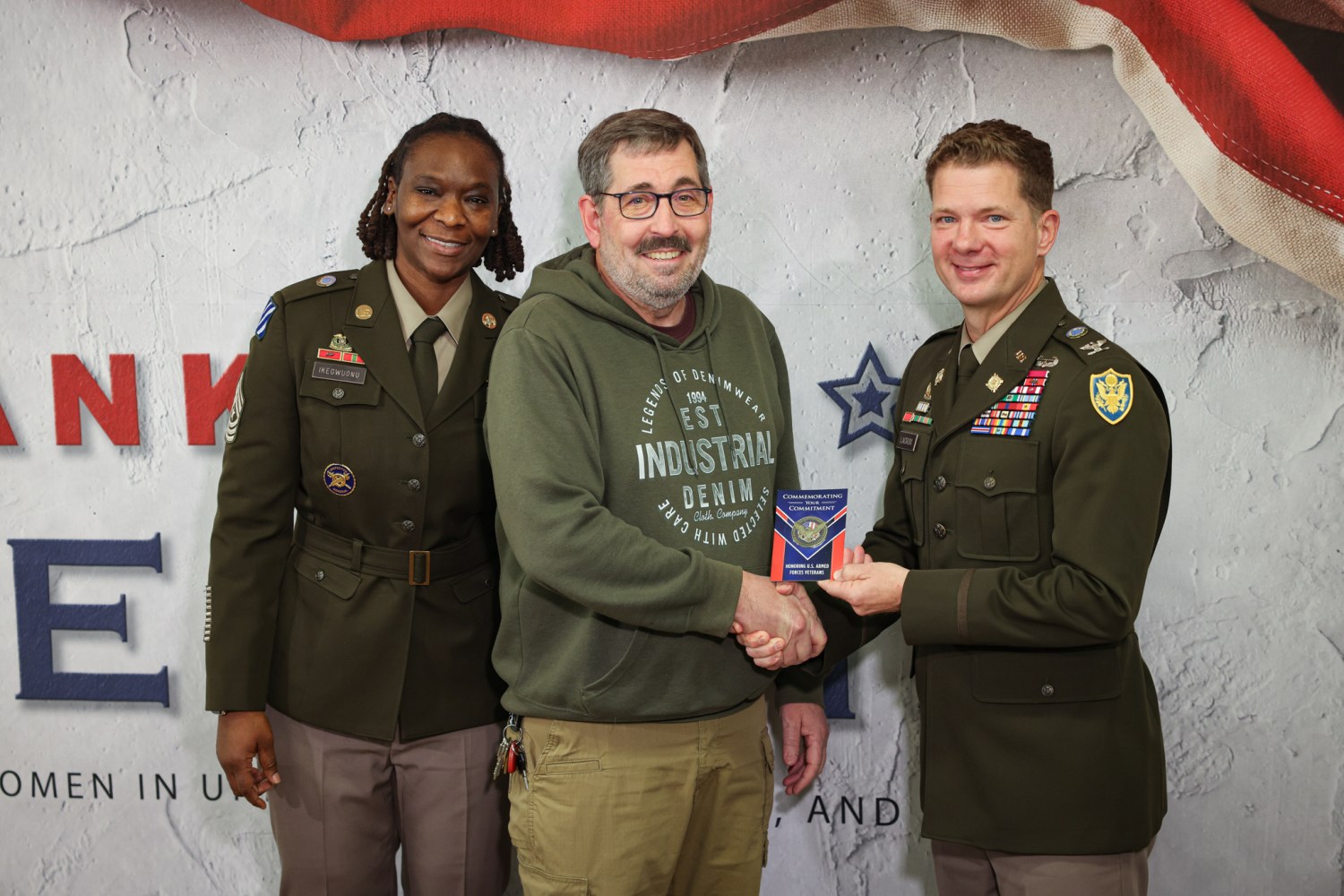
From left: Europe/Southwest Asia/Africa Region Commander Col. Everett “Bud” Lacroix, right, presents a Veterans Day commemorative coin to Field Technical Supervisor Mark S. Draper at Europe HG. Lacroix and Europe/SWA/Africa Region Senior Enlisted Advisor SGM Ashley Ikegwuono, also pictured, honored associates who are Veterans with coin presentations on Veterans Day 2024.
Since he enlisted in the Air Force in 1998, Martinez says he has either received or given coins for excellence. “When somebody does something outstanding, you recognize that by putting the coin in the palm of their hand, shaking their hand and saying, ‘Thank you for what you’ve done,’” he said. “It’s meant to be a less-than-formal recognition.”
The ”challenge” part comes after the coin has been received.
“You’re always supposed to have the coin on you when you’re a military member,” Martinez said. “If somebody pulls out a coin, it’s a challenge to everybody else in the room. If there’s anybody without a coin, they’re responsible for buying a round of drinks. I’ve seen that happen, but not very often. If everybody has a coin, then it’s the person who originally dropped the coin who has to pay.”
Coins come in different sizes; another version of the challenge is that if two people pull out a coin, the one with the smaller coin pays for the drinks.
In the 2017 Department of Defense article, Air Force Historical Research Agency archivist Barry Spink says he believes the coin tradition, or at least the challenge part, started during the Vietnam War, when an Army infantry-run bar tried to keep non-infantry away by forcing them to buy the whole bar drinks if they couldn’t prove they’d been in combat. When the proof got a little out of control—it occasionally involved unexploded ordnance—a coin-size item with the unit’s insignia became the accepted form of proof.
Martinez, who joined the Exchange in June, began carrying the Exchange senior enlisted advisor challenge coin at the beginning of October. During a recent trip to Exchanges in Korea, Okinawa and mainland Japan, he presented it to nearly two dozen associates.
“My coin is a little different from what folks may have seen in the past,” he said. “Because it’s in the shape of a Chief’s chevron on the front. On the back, it has the Exchange logo. It’s a pretty neat coin. I want the senior enlisted advisor who follows me to feel comfortable using this until they get their own design.”
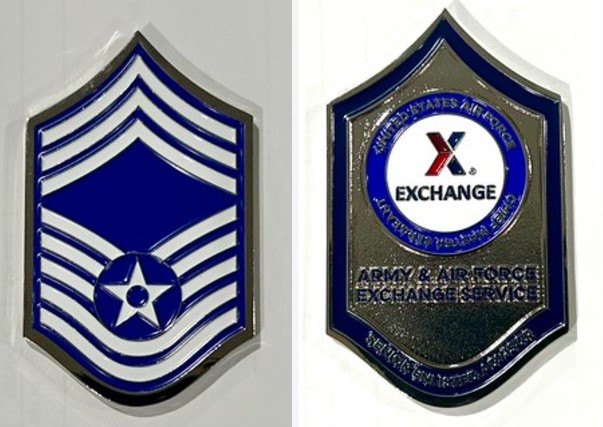
Senior Enlisted Advisor Chief Master Sgt. Rich Martinez’s Exchange challenge coin is in the shape of Chief’s chevron, with the Exchange brand on the back.
The practice of Exchange leaders presenting challenge coins to associates appears to have begun with Maj. Gen. Allen “Doug” Bunger, who was commander from July 1995 to April 1998. Although there are instances of associates receiving coins from installation commands before Bunger’s arrival, stories in the Exchange Post archives about internal coin presentations start to accelerate in early 1996, when Bunger presented the commander’s coin to four Kirtland AFB associates for their outstanding customer service.
Along with Shull, more than a dozen Exchange leaders have challenge coins. These include regional and directorate leaders at the senior vice president level and above.
“I think it’s cool that the challenge-coin practice has been adopted by a lot of the directorates,” Martinez said. “Some folks who never served in uniform have adopted it as a standard for how you recognize people for outstanding professional behavior. It reiterates the fact that the Exchange is a part of the Department of Defense.
“Although some senior leaders didn’t serve, they recognize what the coin means in the military community and they continue to grow the understanding and use of coins by providing their own coins,” he added. “It’s a way of putting your stamp on the organization, because you have a coin that was developed for your time at the organization.”
If you have additional information about challenge-coin history, or the history of Exchange leaders presenting coins to associates, please tells us about it in comments.
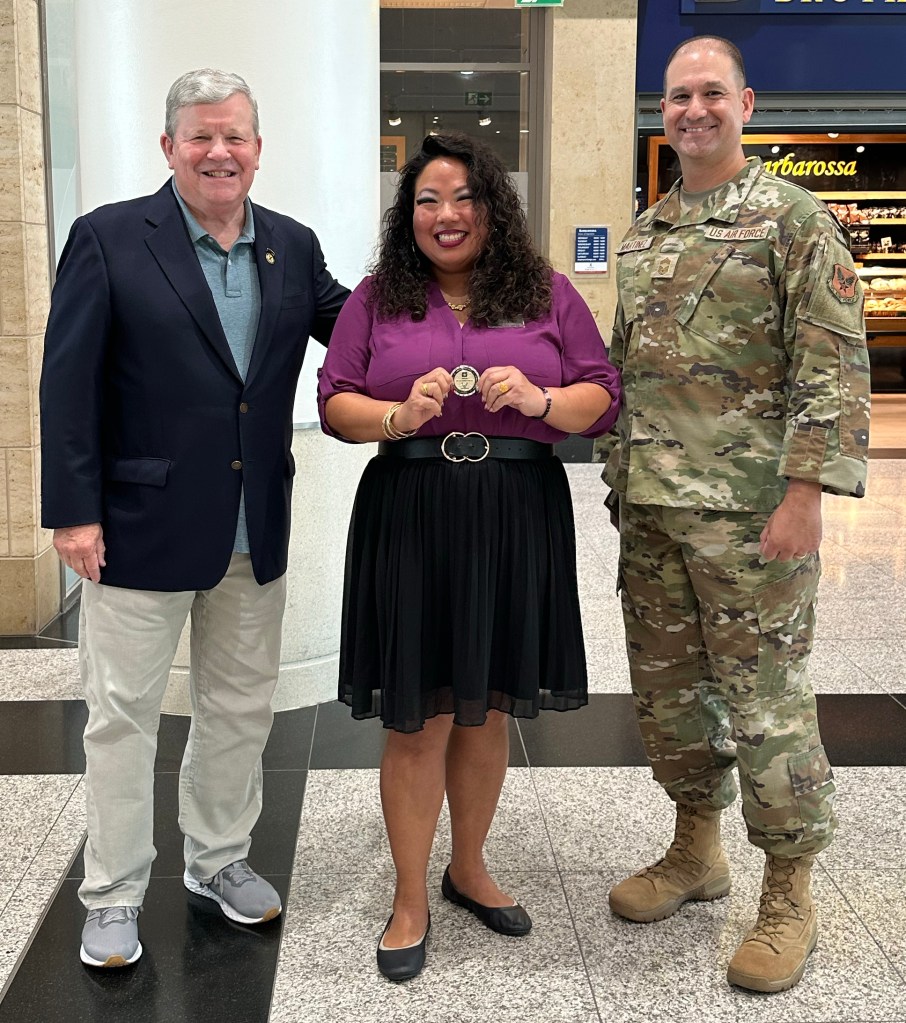
Exchange Director/CEO Tom Shull has presented his challenge coin to hundreds of associates. In June, he recognized more than a dozen Kaiserlautern Military associates for their commitment to serving those who serve and have served. Pictured, from left: Mr. Shull; Anjyla Krzynowek, KMCC Services business technician; Chief Master Sgt. Rich Martinez, Exchange senior enlisted advisor.



Leave a Reply to Gary Covey Cancel reply