


Growing up in West Germany, Jason Rosenberg lived a German life. The son of a German mother, he went to German schools and learned to speak and write fluent German. He had lived in the United States when he was a small boy, but his coming-of-age memories are of Germany.
But there was one very American part of his life growing up: the Exchange.
“The only American contact I had was going to the BX, the PX and the snack bar,” said Rosenberg, now the Exchange’s president.
“We’d go to the American hospital in Landstuhl, where my mom worked. My grandfather was retired military, so we had access to AAFES. We’d shop, and I’d get my video games there. I loved going to the snack bar in Zweibruecken and getting a cheeseburger and a milkshake.
“After I graduated high school, my parents said, ‘You’re going to need an ID card if you want to not pay $100 for a tank of gas, because you’re not a dependent anymore,’” he said. “They told me that AAFES would give me an ID card if I went to work for them.”
Rosenberg applied, not seeking any specific position. All he had on his resume was an internship as a physical therapist at the Landstuhl hospital when he a student. He was hired in June 1989 at the Zweibruecken main store as a summer hire custodial worker, making $1.75 an hour.
So began an Exchange career that culminates with Rosenberg retiring Jan. 31.
“That’s the story of how I landed at AAFES,” he said. “I was trying to figure out what to do with my life, and now it’s been 35 years.”
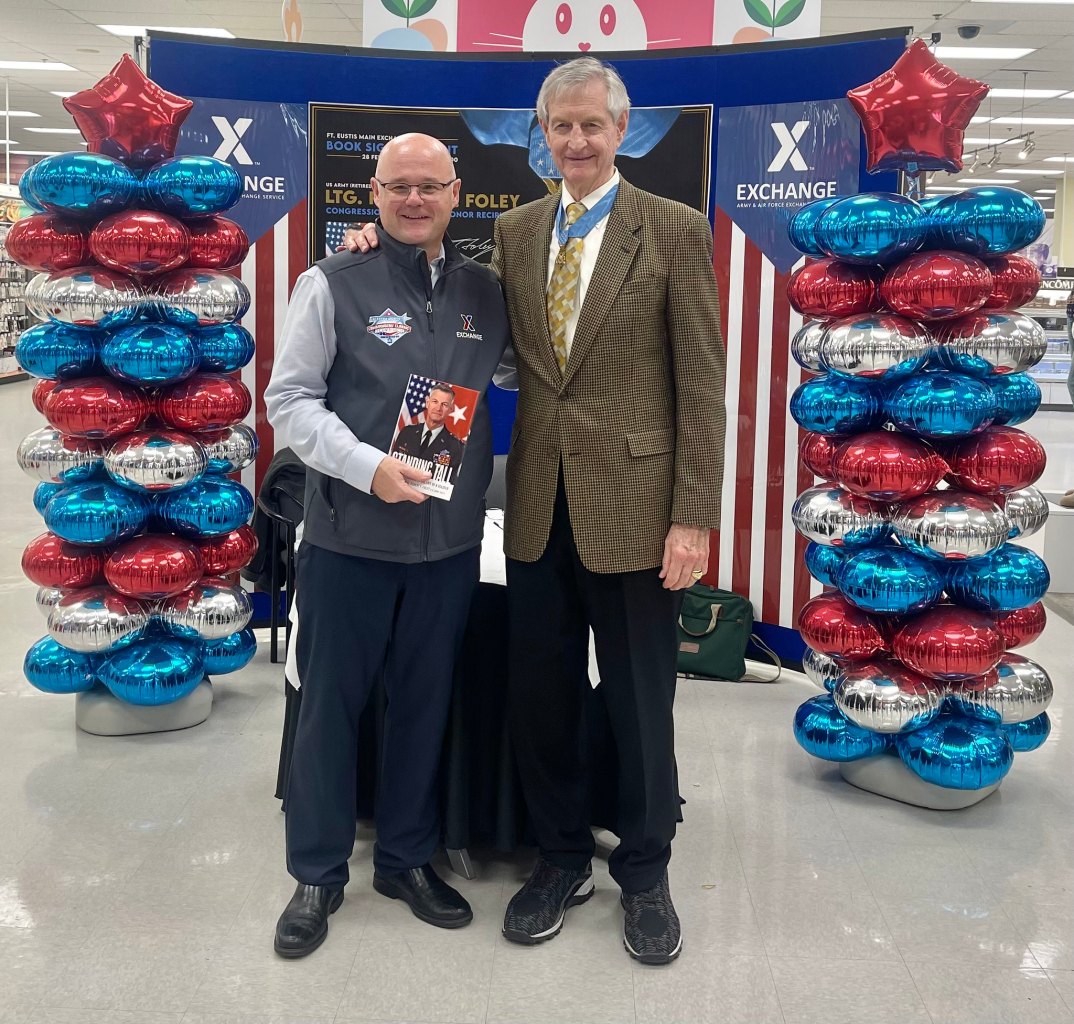
The early years
Rosenberg was not a custodial worker for long. He quickly moved to sales associate in the Sight and Sound Center, now known as PowerZone. His first paycheck was $100. He spent it all on CDs.
He fell in love with the job as he tirelessly pursued competitive career opportunities.
“It took me two years to become a supervisor,” he said. “I had a boss who interviewed me three times. Finally, a new store manager came along, and I applied again.”
The fourth time was a charm—Rosenberg was named supervisor of Sight and Sound, overseeing three associates.
A few months later, word came that Zweibruecken Air Base would close in about 18 months. The manager of the base Shoppette was PCS’ing, creating a job vacancy. Rosenberg’s boss, Tina Wilkins—who retired from the Exchange as Tina Lovett—called him into her office.
“She asked, ‘What do you want to do with the rest of your life? Do you want to be a supervisor in Sight and Sound, or do you want to be a manager?’ She said it in kind of an aggressive tone. I said, ‘Well, I guess I want to be a manager, since you’re kind of yelling at me.’ She said, ‘Good.’”
On the spot, she gave him a mobility statement—by signing it, he agreed that the Exchange could send him anywhere. Then she gave him a manager nametag and told him he was the Shoppette manager.
“There was no training,” he said. “There was no Retail Management Academy at the time. I knew I had about 18 months to prove myself. About three months into the job, we had a visit from [Europe Region Chief of Field Operations] Harry Marshall.”
Marshall walked through the store and didn’t say a word to Rosenberg, who had been there since 2 a.m., waxing and stripping the floors, mopping, cleaning and stocking. As they were wrapping up, the visiting senior leader asked Rosenberg to confirm he had signed a mobility statement.
“A week later, I received orders to go to Mannheim as a sales area manager,” Rosenberg said.
The 55-mile move to Mannheim was the first of many that would take him around the world and back again.
“AAFES was investing in me,” he said. “I was inspired and passionate about the mission.”
In January 1994, Rosenberg moved to the Heidelberg main store, where he held positions including assistant retail manager, sales area manager and annex retail manager.
Rosenberg next received orders to head to the UK. It would be the first time he lived outside of Germany as an adult.
England Calling
In 1996, a 26-year-old Rosenberg arrived at the RAF Croughton Exchange, about 75 miles northwest of London.
“It was the smallest main store in the world,” he said.
It may have been a small store on a small installation, but Rosenberg said that it played a big role in shaping who he is now.
Bob Smith, his GM at the time, liked to say, “If you heard Jason talking about Croughton, you’d think it’s the biggest store in the world. Because he acts like it’s the biggest store in the world.”
The Croughton store didn’t get a lot of visits from Exchange leadership. His general manager came by once a month. The senior vice president didn’t come by often. It’s one of the reasons Rosenberg, as an SVP and then COO and Exchange president, focused on visiting locations of all sizes.
One 1999 visit by Europe SVP Mike Cunningham proved pivotal.
“He was so impressed with the store, our attitude and our financials,” Rosenberg said. “He asked me how long I’d been with AAFES, and I told him 10 years. He said, ‘You’ve never been to the States? If you go to the States, I guarantee you’re going to be a superstar there. I want you to write your career manager and tell them you’re willing to go to the States.”
After Cunningham left, Rosenberg wrote to his career manager. The next day, he received a call from Career Management. He was going to the States.
Coming to America
Rosenberg received orders to become the main store manager at Whiteman Air Force Base, in Knob Noster, Missouri, roughly 70 miles southeast of Kansas City.
“It was not exactly a metropolitan area,” Rosenberg said. “But it was the best assignment I could’ve received at the time, because it eased me into America. It was so different from Germany. We’d drive to Kansas City to go to the big mall, and it was just unbelievable.”
Regional Vice President Marty Maston was impressed by the work Rosenberg had done in just eight months. A couple of weeks after Maston visited Whiteman, Rosenberg moved to Fort Hood (now Fort Cavazos) to serve as the sales and merchandise manager. It was a lateral to a position at one of the biggest Exchanges. He learned a lot and four years later, volunteered to deploy to Iraq in 2004.
“The 4th Infantry Division had just captured Saddam Hussein,” he said. “They returned to Texas, and the 1st Cav was moving out. I volunteered to deploy, and 7 minutes later, I got a phone call asking if I could be in Iraq in 30 days.”
Six weeks later, Rosenberg landed in Baghdad and took a helicopter to his new home at Camp Taji.
The rewards of deployment
Rosenberg and the Taji team operated out of an old Iraqi motor pool with no air conditioning. They slept on cots in the store stockroom. Showers and toilets were about a mile away.
When visitors came, Rosenberg greeted them at the helipad, even though most flights came in between midnight and dawn.
A visit from the Ops Squad, a team of six who made their way to Exchange facilities throughout Iraq, would prove to be the most significant visit of his career.
“Ops Squad was the worst,” Rosenberg said. “The team traveled all the time and lived out of backpacks and duffel bags. They’d travel to a place for a few weeks, and then move to another to set up more stores.”
Rosenberg was prepared to meet his visitors when they were scheduled to arrive at 2 a.m.
“I was in my room around midnight, and this is July of ’04, watching ‘CSI’ on my portable DVD player, and there’s an angry knock on my door. I opened the door, and there’s this lady standing there, AAFES uniform, nametag Dennett.”
It was Melisa Dennett, the Ops Squad leader. Rosenberg had never met her, but they had mutual friends.
“In Iraq in July, even at midnight it’s 110 degrees,” he said. “And she’s sweaty and dirty. She had just walked about a mile and a half to the store because nobody was at the helipad to pick them up. I said, ‘Dennett—what are you guys doing here?’ She said, ‘We landed about 11:30!’ I said, ‘Nobody told me! I can show you my email. It said 0200 and I was going to be there at 0130 just to make sure.’ She was clearly upset—they’d had to lug all their gear after nobody met them and they had to find their way to the store.”
Despite the rough start, the Rosenberg and Dennett partnership thrived.
“Ten months later, we got married,” he said. “It was a rocky start, but in a couple of months, we’ll celebrate our 20-year anniversary.”
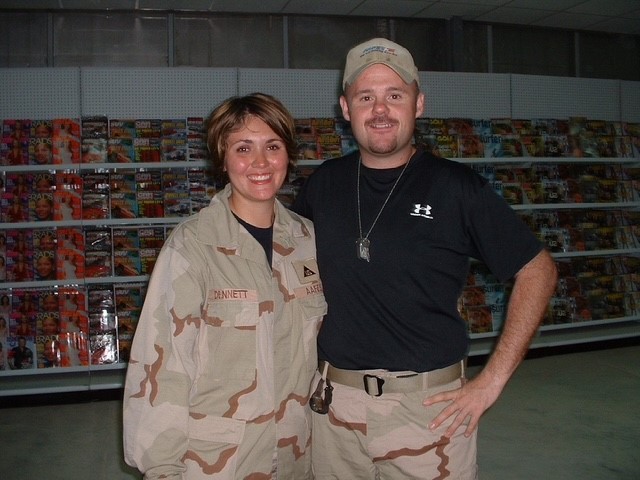
Coming to America, Part 2
Rosenberg had volunteered for a six-month deployment, but he asked for a six-month extension, and it was granted.
In late 2004, Exchange Commander Maj. Gen. Kathryn Frost and Chief Operating Officer Marilyn Iverson came to Iraq, visiting every site, concluding with Taji, which turned out to be one of their best visits.
“At the end of their visit, General Frost said, ‘Jason, ‘I don’t want to offend you, but where is your home duty station? Because I’ve never heard your name before, and I come here, and all this great stuff is happening.’”
Before he could answer, Iverson told Frost that he was the sales and merchandise manager at Fort Hood. Frost asked if he was mobile and how long he’d been at Fort Hood. When he told her four years, the general said she would be in touch.
“A week or so later, General Frost sent an email saying, ‘I have approved orders for you to be promoted. You’re going to Fort Bragg, North Carolina, in November.”
Rosenberg wrote to Connie Gordon, the GM at Fort Bragg (now Fort Liberty), asking her if he could stay in Iraq a little longer so he could open the Taji PX and get it running. She told him he could stay until January.
“I got there in April, and on Thanksgiving Day, we opened the biggest store in Iraq,” he said.
The Stryker Brigade rolled into Taji, and its Soldiers shared their enthusiastic approval.
“About a dozen Warfighters walked in and stood at the front of the store,” he said. “One of them said, ‘They’ve got [expletive deleted] Walmart in Taji!’ That’s the only time I’ve ever considered ‘Walmart’ a compliment.”
Three weeks after the Taji grand opening, Rosenberg returned to Fort Hood to pack and move to Fort Bragg, where he started as main store manager in January 2005.
“I felt like I’d arrived,” he said. “When you’re a supervisor or a sales area manager, you look up to main store managers.”
He stayed at Fort Bragg until 2007, when he moved to Fort Lee (now Fort Gregg-Adams) as general manager. It was a lateral move—a higher-ranking title at a smaller store with big lessons to be learned.
“It was a reminder to not be in a hurry,” he said. “Sometimes a step sideways is a step up. The time I spent at Fort Lee was invaluable, because I wasn’t overwhelmed. I learned how to run more than one store. I had places two hours away, an hour and a half away, little troop stores, and food and services, which I’d never been exposed to. Doing that on a smaller scale was so important.”
In November 2008, Rosenberg moved to Fort Jackson, where he was general manager for nearly two years. The next step was familiar: Ramstein/ Kaiserslautern Military Community Center, where he would be the main store manager at the biggest Exchange in the world.
Coming back to Germany
When Rosenberg was a teenager, his grandmother shared with him she had read that AAFES was going to build the biggest store in the world on Ramstein, right behind the Burger King.
The store that his grandmother had read about in the late ’80s opened in 2009. In 2010, Rosenberg became its second store manager.
“If you had told 16-year-old me that I was going to run that store one day, I would have said, ‘You’re nuts,’” Rosenberg said.
About a half-dozen associates Rosenberg worked with at the beginning of his career were there when he returned.
Some—Susan Doepfner, a supervisory customer experience associates; storekeeper Guido Scharfenberger; and Human Resources Assistant Antje Zirkel, who celebrated her 60th anniversary with the Exchange in 2024 and is the longest-serving current associate—are still there today.
The store turned out to be a success. In 2011, it set sales records for military resale that still stand today.
“We did $22.4 million in one month in December,” Rosenberg said. “Nobody had ever reached $20 million.”
The records landed the store on the front page of the February 2012 issue of Exchange and Commissary News, with the headline, “The Sound of Records Breaking.”“It was a phenomenal year,” Rosenberg said. “Everything came together. For me, as a lifelong retailer, that’s a really cool moment in my career, to be part of that.”
By April 2012, Rosenberg received another assignment that would take him far from Ramstein.
Hawaii, Alaska and bears
From April 2012 to February 2014, Rosenberg was Pacific Region Area Manager. “Area” seems like an understatement for a job with an area of responsibility that included Alaska, Hawaii, Kwajalein Atoll and American Samoa—more than 5,500 miles from one end to the other.
Rosenberg was based in Hawaii, but every month he spent a week at Fort Wainwright, near Fairbanks, Alaska. In the winter, he’d board a plane in Honolulu, where the temperature was in the 80s, and land 16 hours later in Fairbanks, where it was about 30 below.
“I’d always wear jeans and a polo shirt, and my Carhartt jacket was in my checked bags,” he said. “When my suitcase came through baggage claim, I’d put on my scarf, big knit hat and the jacket, and walk out of the airport, usually at 1 or 2 in the morning.”
The first time Rosenberg went to Alaska, the Wainwright GM picked him up at the airport. For future visits, a car with coded locks would be waiting for him, and he’d drive to his hotel.
On his first visit, he saw bears and moose coming out of hibernation. A month later, driving to the hotel alone, he remembered the bear sightings with some trepidation.
“I got to my hotel about 2:30 a.m.—it was still light out, because it’s the time of year when there’s light 24/7,” he said. “I pulled into the parking lot, which was so full that I had to park on the outskirts. I’d seen many bears the month before and was thinking, ‘Surely, they’re all out now.’
“So I laid on my horn for about 30 seconds to scare away bears, jumped out of the car, opened the trunk, grabbed my suitcase and ran to the hotel entrance.
“The desk clerk asked, ‘Was that you on your horn? It’s 2:30 in the morning!’ I said, ‘I was making sure I scared away any bears before I ran to the hotel.’ She said, ‘Where are you from?’ I said, ‘Hawaii.’ And she was like, ‘Ohhhh—OK.’”
Back to Germany—and up to vice president
Rosenberg returned to Germany in February 2014 as Europe Region Area Manager, another lateral move that quickly led to increased responsibility and opportunity.
“At the end of February, the vice president of Europe/Southwest Asia called me and said, ‘I’m going to put in my retirement paperwork for June.’ About 15 minutes later, the SVP of Europe and Pacific, Karin Duncan, called and said, ‘Congratulations, you’re going to be the VP of Europe.’”
Rosenberg assumed the regional vice president role in June 2014. It was a return not just to Europe but to Southwest Asia, where he traveled to twice a year to visit Exchanges.
Three years later, OCONUS was separated into two separate regions, Europe/SWA and Pacific. Rosenberg was named SVP of Europe/SWA/Africa.
As Europe Region Area Manager, VP and then Europe/SWA SVP, Rosenberg oversaw the surge and drawdown of Exchange activities in Southwest Asia and the beginning of operations in Poland. His time in Europe ended in July 2020, when he was named the Exchange’s COO, his first headquarters assignment…in the middle of a global pandemic.
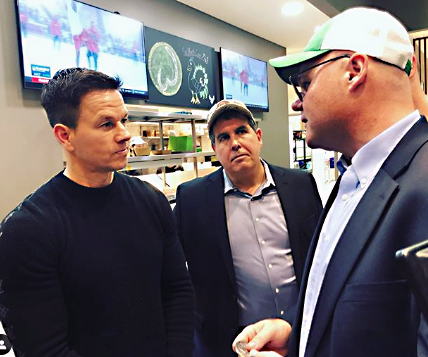
COO and COVID
In February 2020, Rosenberg and his family took a Presidents Day weekend trip to Rome, one of their favorite cities.
“When we landed, there were these guys in big white suits, checking people’s temperatures,” Rosenberg said. “My wife said, ‘What’s that about?’ I said, ‘That must be because of COVID. I heard that there’ve been a few cases in northern Italy, so they’re probably checking for that.’”
Rosenberg, his wife and two daughters visited the usual tourist destinations—the Vatican, the Sistine Chapel, etc. “Everywhere we went was crammed with people,” he said. “We flew home, and everything still felt normal. And then two weeks later—I never returned to my office in Germany and my kids would never return to school there.”
Less than a month after Presidents Day, a pandemic was declared, and the Exchange had to quickly adapt. Associates who could started working remotely. Masking was required as a precaution. Social distancing—standing 6 feet apart—was mandated. Shoppers ordered products online and had them delivered or picked up in parking lots.“We were improvising,” Rosenberg said. “The organization was determined to keep operations open and protect our teammates. In Europe, we took the plastic shield off the 22-by-28 sign holders, poked holes in them and used sign wiring to hang them as shields. It became a best practice for AAFES, because it was hard to find Plexiglass.”
Once vaccines were introduced in spring 2021, in-store demand started to return, but Rosenberg said that the Exchange emerged better than any organization he knows of.
“There are restaurants and retail companies that no longer exist—they never made it out of COVID,” he said. “To deliver the performance that this organization did in 2024, not that long after the pandemic, is unbelievable. I’d put us up against any organization or company in the world.”
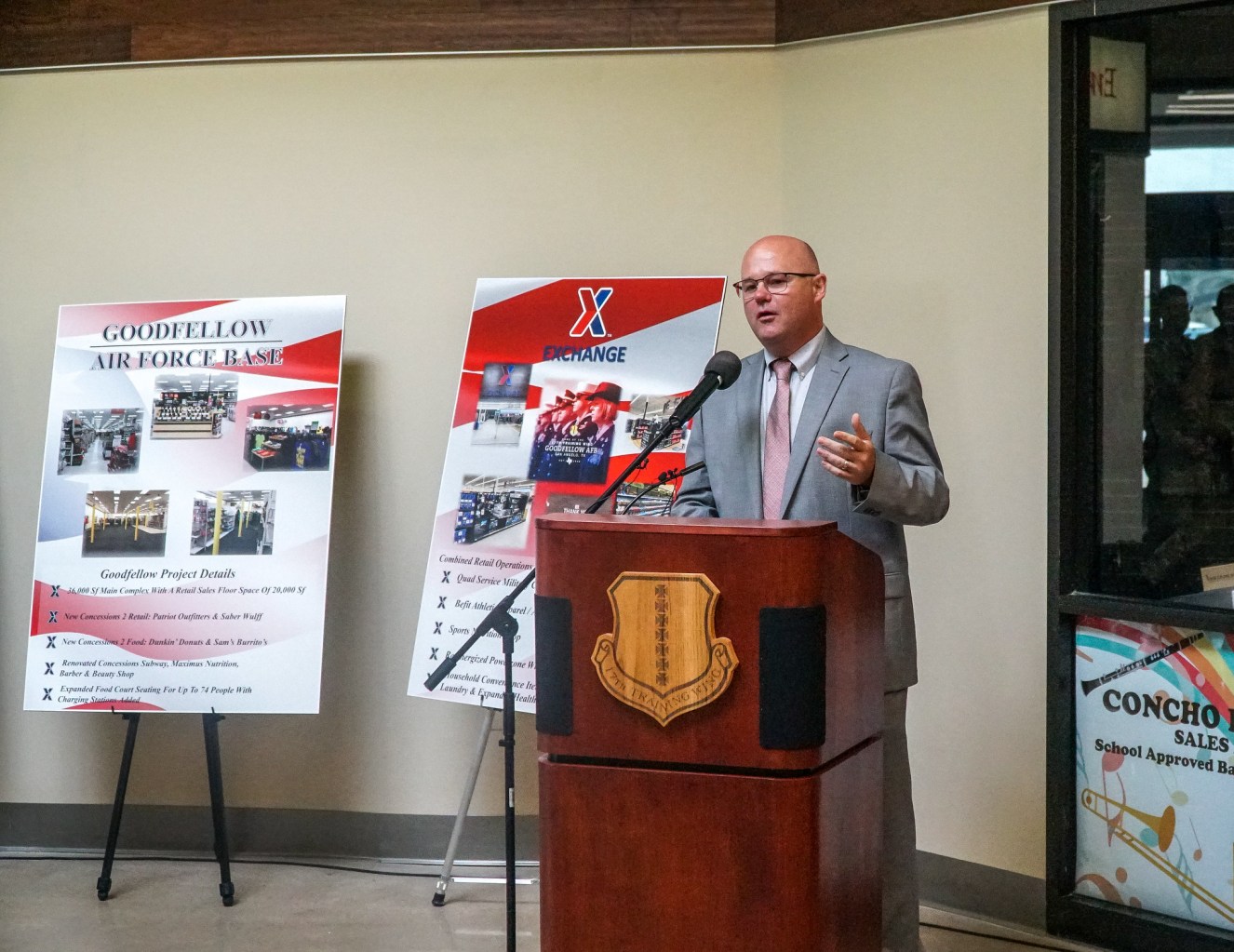
Retiring as president
In March 2024, as part of a leadership reorganization, Rosenberg became president of the Exchange, leading alignment of Merchandising, e-Commerce, Services and Food and Store Operations.
It is in this position that he will end his nearly 36-year Exchange career, which started with a summer hire custodial job.
“Man, I started this at $1.75 an hour, and my goal was to be a main store manager,” he said. “I thank God for giving me this opportunity. I hope I’ve inspired people. I don’t know how many retirements I’ve been to where I’ve told the story of an executive starting as a cashier or a sales associate. This organization gives people that opportunity. I’m living proof of that. If you work hard, take care of people around you and have passion for the heroes we serve, the sky’s the limit.”



Leave a Reply to Gaymarie Alcasid Stromer Cancel reply