


One of the worst disasters in Exchange history happened 62 years ago today.
About 5:35 p.m. March 27, 1964, Anchorage, Alaska, was struck by the strongest earthquake on record—measuring 9.2 on the Richter scale—to hit the United States. At the ALCOM (Alaska Command) Exchange, with headquarters at nearby Elmendorf AFB, associates had just locked the central warehouse. Office workers were leaving for their homes. It was Good Friday, and some had lingered to wish one another a Happy Easter weekend.
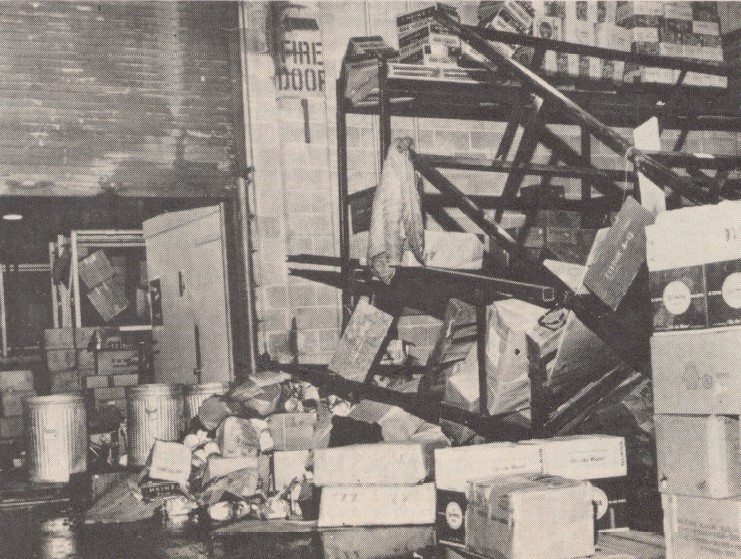
The newly renovated Elmendorf AFB main store had held its grand reopening the previous day and curious shoppers were still stopping by for a look. Five minutes after the quake struck, smashed merchandise filled the aisles. Somehow, although the store was crowded, no one was injured. The store manager and the assistant manager, who were in the office on the mezzanine, crawled down stairs to the main floor, dodging crashing file cabinets. When they got to the main floor, they were the only people left in the Exchange.
Many in the area went without heat for nearly 24 hours, on a night when the temperature dropped to about 2 degrees Fahrenheit.
“Through the night and early next morning, the ALCOM Exchange filled emergency requirements for the base hospital, where all patients had been evacuated to a smaller building housing the nurses’ quarters,” the Exchange Post reported in a May 1964 story. “[Hospital officials] were asking for flashlights and batteries, baby bottles, electric lamps and disposable diapers.”
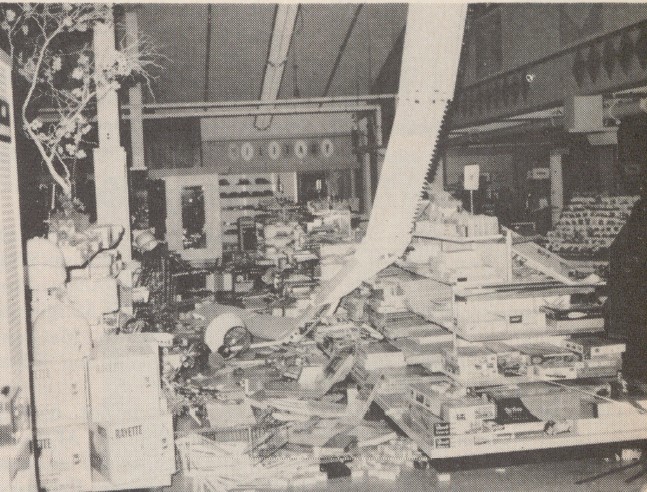
At Fort Richardson, where damage was less severe than at Elmendorf, the main Exchange and cafeteria were serving customers by 10 the next morning. At Elmendorf, an all-out effort ensued to get three Exchange ”groceterias” (primarily food stores but with additional merchandise such as over-the-counter medicine) into operation to provide customers with essential items.
Lines began to form early, with customers asking for batteries, camp stoves, fuel, candles and more. All three groceterias opened by 10:30 a.m. and were able to fulfill the requests.
Alaska Area associate Eileen Molitor shared her earthquake story in the Exchange Post, writing that as she drove home, she looked at a bank clock and checked her watch. It was 5:36 p.m.
“That was [my] last recollection of time until about 10:30, when someone handed me some food,” Molitor wrote. “The earth tremor began and seemed like every other earthquake and then suddenly it was no more that way but something so overpowering that one just sat still and prayed.”
The quake stopped. Molitor nervously and slowly began to proceed home. Then she turned onto a gravel road—or what used to be one. Instead, there was a crevice she estimated to be about 100 feet deep, preventing her from getting to her house. Walking through snow up to her knees, she found a spot where she could see her house, with her husband and dog safe in the back yard.
She drove to a friend’s People across the street from their friends’ house came over to get some heat from the fireplace. All three families spent the night at the house, huddling under blankets and listening to news updates.
(Molitor, who died in 2001, continued to work for the Alaska Exchange until her retirement in 1976.)
About five hours after the quake occurred, Deputy ALCOM Exchange Officer Maj. James M. Hull received a call from an Exchange employee on a business trip to Fairbanks, roughly 360 miles away. The associate, who had tried for hours to call his home, finally reached Hull through a direct-dial system linking all Alaskan Army and Air Force installations.
After several futile attempts to reach the associate’s family, Hull decided to drive to their home. At first, Air Police wouldn’t permit him to leave the base because of dangerous driving conditions, but they allowed him to when they learned of his purpose.
As Hull neared his destination he saw that the road directly in front appeared to lead through a ravine. Sensing that something wasn’t right, he stopped the car, walked forward about 50 feet, and stood on the edge of a gigantic crack in the earth. Looking down, he saw the rooftops of two houses that had fallen into the crevice.
Noticing that the place where he was standing was unstable, Hull returned to his car. Taking another route, he managed to contact the associate’s family and determine that they were okay.

Share your thoughts!