
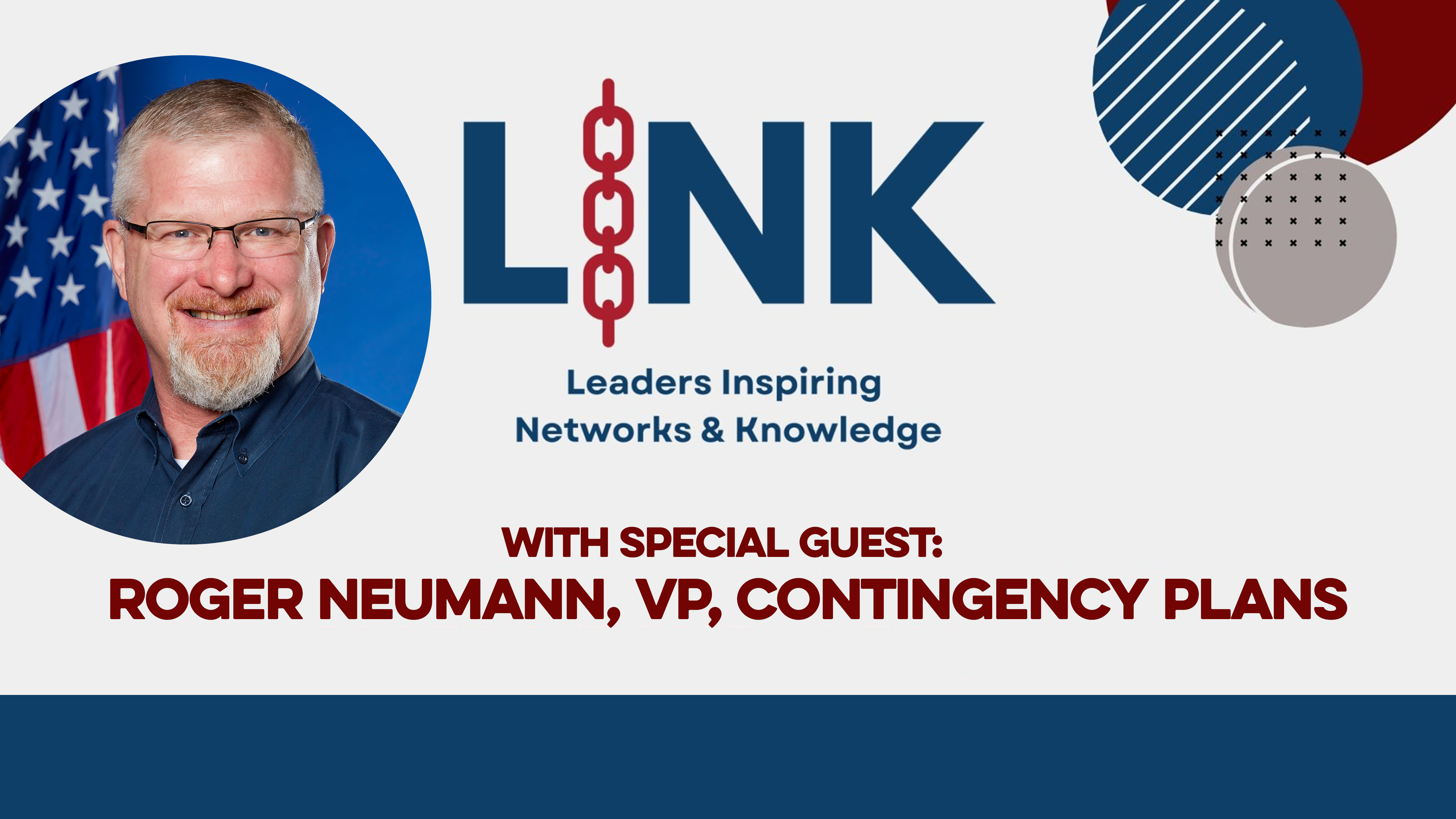

When Roger Neumann was commissioned in the Air Force as a second lieutenant in 1990, he began of wisdom learned as his military career developed. As this collection grew and he climbed in rank, he began sharing the information with younger officers as they were coming up in their own careers.
He also realized that they could be valuable at the Exchange, which he joined in 2012 as an Air Force colonel. After retiring from active duty in 2014, he continued to serve as a member of Team Exchange, where he is now vice president of contingency plans.
Neumann shared his stories and advice March 25 in a LINK (Leaders Inspiring Networks & Knowledge) presentation titled “Twelve Mentorship Points for Rising Leaders.” Here are some highlights.
Actively manage your public image: “Each of us has a public image that we are always broadcasting, especially now with social media,” Neumann said. “If the thing you are considering doing [is] plastered all over social media, can you stand by your actions and words? I suggest you not leave your public image to chance.”
Neumann related an Air Force experience to this. After his initial assignment at Yokota Air Base, he was assigned to Charleston AFB, where the culture was much more competitive than at Yokota.
“One day, my senior master sergeant says, ‘Hey boss, we need to go take a ride in the truck and have a private conversation’,” Neumann said. “And he says, ‘hey, there’s a lot of people talking about you and not in a good way.’” I had made some mistakes, but my NCO’s advice was, “Actively broadcast the good things that you are doing. Don’t go to mudslinging mode, just start broadcasting your own goodness.”
“I took that to heart. I went on to Incirlik [Air Base in Turkey] and applied those lessons learned. In 1999, I got Wing company grade officer of the year, 16th Air Force transportation company grade officer of the year, and other nice awards because I applied that lesson. So manage your public image – don’t just leave it to chance.”
Dress for success: In his first assignment as a second lieutenant, Neumann took over a vehicle maintenance shop from a captain. “She was well-seasoned, used to be a drill sergeant, she was really squared away,” he said. “She says, ‘You know we get inspected every day, right?’ And I said, ‘Ma’am, really? The commander does open ranks inspections every day?’ She said, ‘Nope. Here’s how it works. You walk in the door and your troops [look you up and down]. And you just got inspected. They just gave you the once over head to foot … . They know what right looks like because they know the regulations. And if your uniform is not squared away, what do you think that does to your ability to lead that organization?’
“So I always have myself professional, squared away, whether it’s in civilian clothes or when I was in uniform back in the day.”
Work your boss’ boss’ priorities: “We’ve heard throughout our careers, work your boss’s priorities,” Neumann said. “That’s true. But if you take it one level higher, you are not only helping your boss, you’re helping the organization. Every organization has parts that fit together, beginning to end. Think in organizational effectiveness end to end. What works best for the entire organization, not just your piece, because you can run into suboptimization problems.”
Nobody cares for your career tike you do: “There’ll be good bosses that you will learn from and want to emulate,” Neumann said. “There will be bad bosses you will also learn from and want to shy away from. Leaders come and go, but you are the only one who is invested in your career from beginning to end. Records get promoted. By helping your boss get good things into your record, you make it easy for your boss to sign on the dotted line. You get a good report and it ends up in your record. And that’s ultimately good for you.”
Plan, but bloom where you are planted: “Have a career plan. Be very open about what it is you want to do. Talk to your boss and their boss about where you’d like to go next and serve. But don’t forget about your day job. The most important job you’ll ever have is the one you’re in. That is an old saying, and there’s a lot of truth to that.”
Six steps to success: think, think, think—work, work, work: “If those get out of balance, if it’s all working and no thinking, that’s a problem,” Neumann said. “If it’s all thinking and no working, that’s another problem. [Doing] lots of both is critical, and make them fit together.”
HQ vs. field—know the other side: “The most effective leaders I’ve seen are the ones who understand both,” Neumann said. “Usually because they’ve been bouncing back and forth between those worlds and understand what the other side needs and then push it to them. Keep communicating because the needs change, the targets move. If you’re still shooting at the old target, but it moved, now you’re missing the target.
“Understand who your counterparts are on the other side. Talk to them routinely. Understand their needs. Actively push what they need.”
Don’t “show up and throw up”: Neumann credited this one to another retired Air Force colonel, Exchange Vice President of Outreach Andy Weaver.
“This is when you go to your boss and say, ‘I have a problem,’” Neumann said, “And then verbally vomit: Oh my God, look at that problem. It’s all wet and smelly and gross. Oh my God, look how big and heavy it is – but then offer zero options to consider. And then the boss says go, ‘OK, solutions. Anyone? Anyone?’ And they look at you”
Instead of just coming in with a problem and expecting help, Neumann said, come in with potential solutions.
“Put some brain cells on the problem and come in with an analysis of possible courses of action,” Neumann said. “What are the options that we can take to deal with this problem? And what’s your analysis of those courses of action? … And then the boss gets an educated, thought-out list of possible solutions to choose from. That’s what you really owe your boss.”
E-mail sent does not equal task complete: “You’d think I wouldn’t have to say this, but I have to because I’ve seen it over and over and over and over and over,” Neumann said. “Follow up, follow up, follow up, keep following until you either resolve the question or are completely out of options and need to elevate. Be able to tell your boss how you tried to go over, under, or around the problem and have ‘run out of airspeed and altitude’ (an old Air Force term) so now need higher level engagement that you can’t complete on your own.”
Death to (undefined) pronouns: In other words, be specific when you’re referring to person or group.
“If you’re talking about Mary and Sue in the previous sentence, and then you said, ‘well, and she agreed,’ which one was it? Was it Mary or was it Sue? Because if you don’t define it, you leave wiggle room for your audience and somebody’s going to misinterpret it.
“Use as few pronouns as possible. If you do, make sure there’s no room for misinterpretation of who we, she, they, him, us are. I wear a lot of hats, so when I say ‘we,’ I generally define which ‘we’ we are talking about.”
Listen—people say the strangest things: “You can learn a lot of stuff, whether you agree or disagree with someone, by asking an open-ended question and then doing some active listening,” Neumann said. “There are techniques for active listening. Maintain eye contact. Watch for non-verbal cues, body language, gesturing, take notes.”
Neumann said that when someone is talking to him, he’ll take notes, so that afterward he can ask the person if he heard and understood everything correctly.
“If the answer’s ‘no,’ OK, great. Help me understand,” he said. “ ‘Help me understand’ is one of my very favorite phrases. It conveys interest, it conveys respect that you recognize their expertise. And when people know you care, are listening and trying to get it right, they will open up.”
What do you really want? “It’s not just about the job, it’s about your whole life,” Neumann said. “If you haven’t lately, take some time, leave your phone in the car, bring a chair, sit by a lake or something like it. Give yourself a couple of hours. Do some soul-searching about what is important to you. Because ultimately the one you have to face is the one in the mirror.
“It’s not just your work. It’s also your family and it’s health, fitness, all the things that make you into you. There are going to be some trade-offs along the way. Make sure that those are consciously decided upon and you are on the path that you want to be on.”
LINK (Leaders Inspiring Networks & Knowledge) aims to strengthen workplace culture, boost morale and reinforce the value of connection. Each month, a senior leader hosts a session via Teams aligned to key business priorities.
Active associates who missed Neumann’s presentation, or want to view it again, can watch it here.


Leave a Reply to Roderick D Klugh Jr. Cancel reply