

Flashback Friday goes deep this week—128 years deep, back to April 24, 1898, when Spain declared war on the United States, marking the official start of the Spanish-American War.
The war lasted less than a year, but would prove to be pivotal in the life of the Exchange, which would mark its third anniversary three months after the war started.
When the War Department authorized an official post exchange system in July 1895, the original regulations didn’t provide for a system of sending exchanges into the field with the troops. But the regulations didn’t prohibit such field exchanges, so having an exchange was left to post commanders and their exchange officers.
Before the war, the peacetime Regular Army numbered around 28,000. In a few short months it grew nearly tenfold, with 275,000 regulars and volunteers by the end of August.
Two supply bureaus, the Subsistence and Quartermaster Departments, were responsible for feeding, clothing and equipping this force. But with the sudden increase in the Army, the departments could not meet the demands of the field.
During the 10 months of the war, the United States sent troops to Cuba, Puerto Rico and the Philippines. On July 7, 1898, the U.S. annexed the Hawaiian Islands to provide a staging point for deployments to the Philippines.
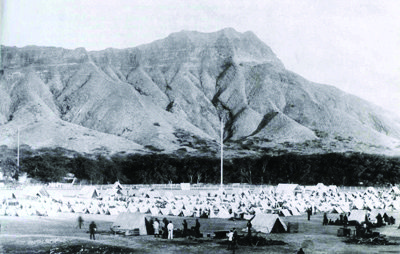
The Quartermaster Department provided the troops in the field with everything but subsistence items. At the permanent garrisons, however, units established and operated their own post exchanges. That included the installations in the Hawaiian Islands. The first PX in Hawaii opened Aug. 16, 1898, in a tent city at Camp McKinley, near the base of Diamond Head.
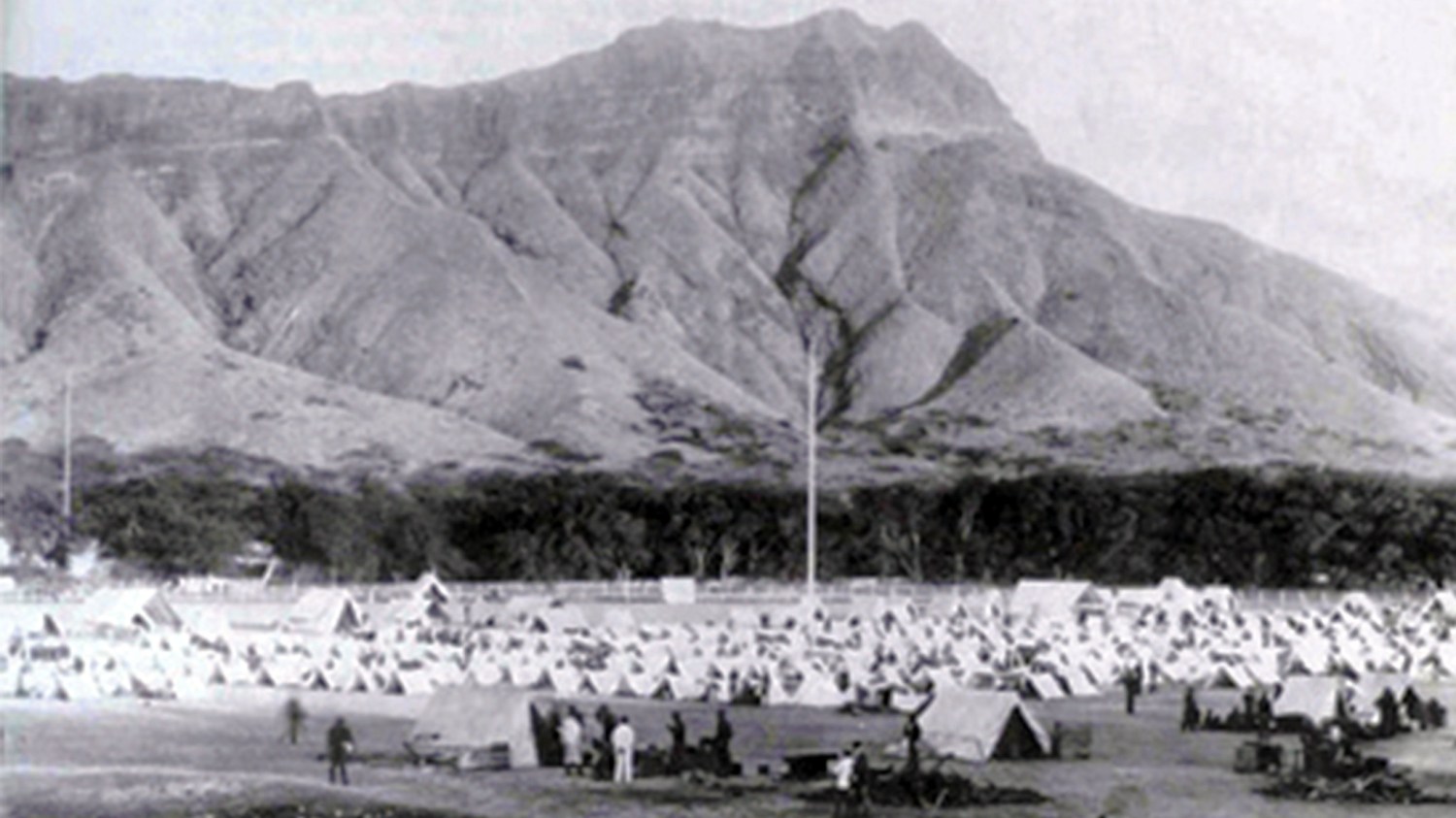
Camp McKinley, Hawaii, site of the first post exchange in the Pacific. It opened Aug. 16, 1898, during the Spanish-American War.
The war ended when a peace treaty was signed Feb. 10, 1899. Spain ceded the Philippines, Guam and Puerto Rico to the United States. As garrisons were established in each of those areas, permanent post exchanges were established by the commanders, relieving the Quartermaster Department of running the stores.
The Exchange continues to operate in Hawaii, Guam and Puerto Rico. The Exchange’s history in the Philippines dates to 1903, but post exchanges were closed in World War II after Japan invaded the country. After operations resumed in 1945, the Exchange maintained a presence in the Philippines until early 1992, when damage from the eruption of Mount Pinatubo in 1991 forced Clark Air Base to close.
Source: “One Hundred Years of Service: A History of the Army and Air Force Exchange Service” by Col. Carol Habgood, U.S. Air Force (retired) and Lt. Col Marcia Skaer, Air Force.

Share your thoughts!