
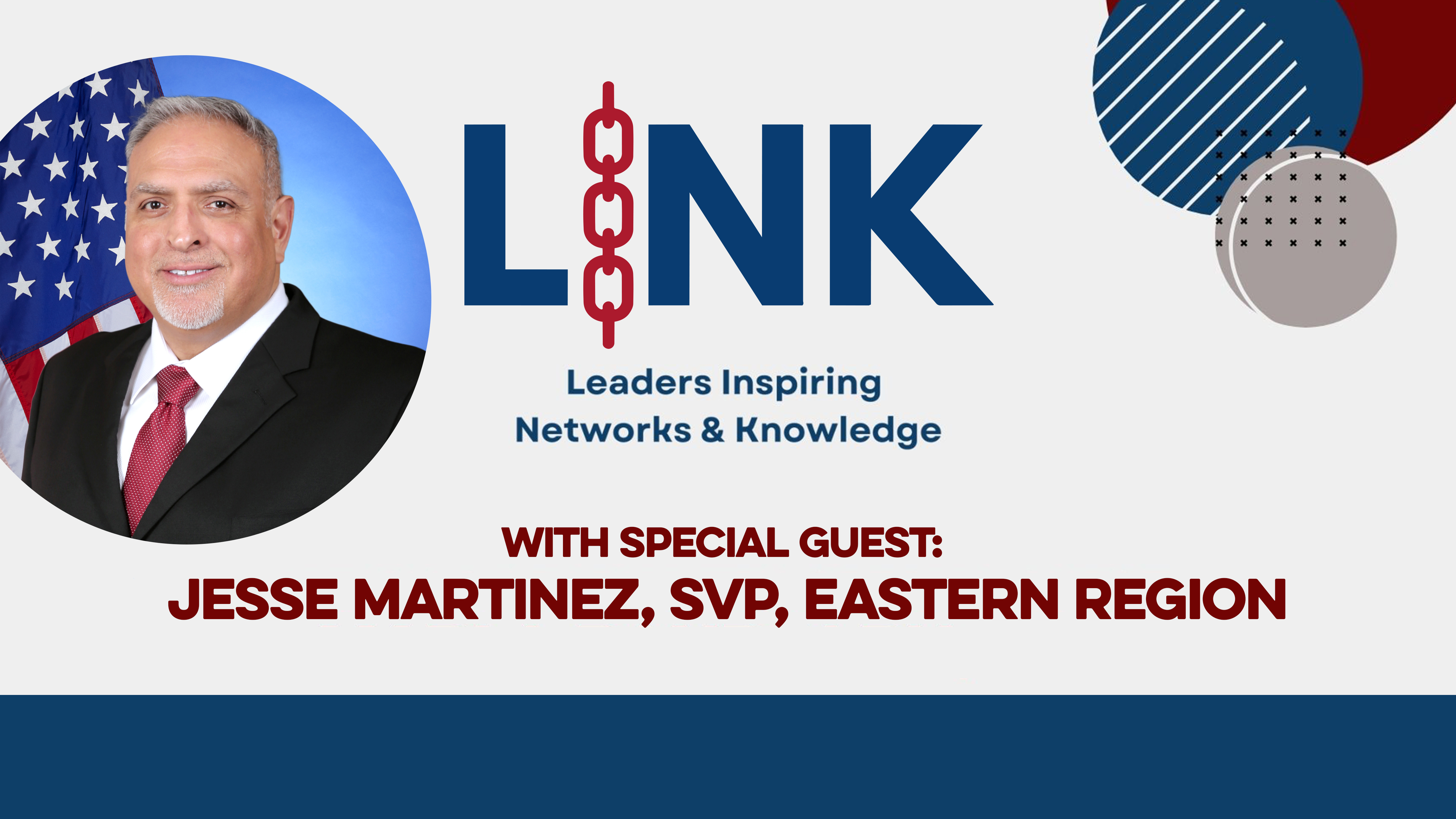

As the Month of the Military Child closed, Eastern Region Senior Vice President Jesse Martinez talked about his journey from military child to Exchange executive during a Leaders Inspiring Networks & Knowledge (LINK) presentation.
The presentation “Bloom Where You’re Planted” was also about adaptability—something Martinez understands, having moved multiple times as the son of a Soldier and PCSing 13 times during his 33-year Exchange career, the latest coming just this year as he assumed the Eastern Region Senior Vice President position after serving three years as Pacific Region SVP.
“The phrase ‘bloom where you’re planted’ is simply another way of describing adaptability,” Martinez said. “It’s how you adjust and learn and thrive in new situations. Whether it’s a new assignment, a new boss or your family adjusting to a new home or school, change is constant.”
Martinez’s father joined the Army at age 17 in 1966.
“When he first enlisted, my dad did not have a high school diploma,” Martinez said. “He later earned his GED in the Army and a college degree. And after reaching E7, he received his commission as a warrant officer and he retired as a CW3. I always saw my dad as a hard-working, honest and incredibly intelligent man.”
Being a military child meant moving often. He attended eight schools and was homeschooled. Martinez lived on Fort Bliss in El Paso, Texas; Camp Page in Chuncheon, South Korea; Fort Sill in Oklahoma; Ferris Barracks in Germany; Fort Polk in Louisiana; and Fort Hood, Texas, where he graduated from Killeen High School.
“All of these experiences and places we lived shaped who we are today,” Martinez said. “…you embrace the food, the culture, the people, and more important, you allow those experiences to make you stronger. It helps you view the people, the world in a different way, and it has a lifelong impact. In our home, growing up, education was always viewed as a pathway to success. My parents consistently supported our education. It was never a question of whether we would go to college.”
Martinez said that both of his parents came from humble, hardworking families and wanted better for their children.
“Because of his military career, my dad was often away,” Martinez said. “The Army sent him on frequent field exercises while we were stationed in Europe. Later in his career, he served several hardship tours, including the one where he took us to Camp Page, but there were some where we couldn’t go with him. And those assignments he did without the family. And toward the end of his career, he served in Desert Shield and Desert Storm before he finally retired.”
While his father was away, his mother kept the household running, with help from Martinez and his siblings.
“I took care of the yard, I washed the cars, changed the oil on the cars and handled anything my mom didn’t want to do or couldn’t do,” Martinez said. My sister helped my mom and took care of my younger brother. And my younger brother, well, he was my younger brother.
“My mom was an incredibly strong woman,” he continued. “She raised three children, and she did this often on her own. Being a military spouse, it was hard for her to find a job, much less establish a career with constant moving. And then finding reliable childcare was another challenge. So raising us, that alone was a full-time responsibility.”
This was before the internet, making things slower and more challenging, Martinez said. He recalls his mom receiving so many letters from his dad, who seemed to write every day, that they began to pile up and often arrive all at once.
“The mailman would just drop off a wad of letters,” he said. “She would carefully sort them by date and read them one by one. To my memory, my mom never got rid of those letters. I saw them in a box one time when I was home. They were a very precious treasure for her.”
Sometimes his dad would call from overseas, but the calls were very expensive. They had to be brief but meaningful. There was no social media, FaceTime or email to make staying in touch easier.
“As children, we didn’t fully understand the hardship my parents endured from being apart for so long,” Martinez said. “They were together for 57 years. They kept us busy, focused on learning. There was no time to wallow or misbehave. I would like to say thank you to my mom and dad for always making where we lived feel like a home. I’ve gotten older and I realized how much work it really was.”
Martinez attended Central Texas College in Killeen, earning an associate degree in general studies. He went on to earn a bachelor of business administration degree in marketing from the University of Texas at San Antonio. With help from the Exchange’s Tuition Assistance Program, he earned a master of science in management from Troy State University.
“At the ripe old age of 21, I was what I thought was older and ready to begin my adult life,” he said. “I was able to graduate with my bachelor’s and thought, ‘I’m ready to go out there and see the world on my own terms.’ I realized something important. Even though I never wore a military uniform, the military never really left me. The values, expectations, and sense of responsibility stayed with me. I wanted to continue traveling the world, but do something meaningful, so I joined the Peace Corps.
“But as fate would have it, and with some strong influence from my parents, I changed course and joined the Exchange instead. Honestly, what happened was my mom was very upset that I joined the Peace Corps. My dad begged me to pursue something different, so I joined the Exchange.”
Working for the Exchange brought him right back to the environment he grew up in. He married his wife, Torii. They had two children, Alex and Belle. And they grew up moving around, much like he did. But they were Exchange brats.
“[It was] so much like my own childhood,” Martinez said. “Our family moved a lot. There was a lot of change, a lot of things to adapt to, new places, meeting new people, new schools, new beginnings for me, my wife and my children.
“My wife is the daughter of a retired Air Force captain. She has supported my career while sacrificing her ambitions along the way. I’m incredibly proud to share that she’ll graduate with her bachelor’s degree this year. We were young when we got married during her final year of college. And soon after, we moved to Japan. So she didn’t get to finish. But she’s about to graduate.”
Martinez said his family viewed changes as opportunities to build strengths.
“Our children learned early how to adjust, how to say goodbye, how to start over without fear. They learned that change is not something to avoid, it’s something you learn to manage and shapes you into a stronger person and hopefully a more understanding person.”
His family worked as a team, much as he and his mother and siblings did. Responsibilities were shared and expectations were clear. Education was a priority.
“The lessons our parents taught us—discipline, responsibility and pulling your own weight— we passed on to our kids,” he said. “We wanted our children to understand that learning creates options. You may not always control where life takes you, but you can control how prepared you are when you get there. When I look at our children today, I see resilience, adaptability, empathy and pride. The same traits that shaped me as a military brat have carried on to the next generation.”
Martinez noted that he carries the term “military brat” with honor.“Both these titles, AAFES brat and military brat, matter deeply to me,” he said. “They represent communities built on service, sacrifice and support. What the Exchange does matters. I grew up shopping at Exchange stores with my family. I understood how important that resource was to my family, even as we moved and worked for the Exchange around the world.
“Recently, the Exchange has updated the policies and benefits related to mobility and PCSing,” Martinez told his audience. “The Exchange truly gives you the opportunity to see the world. Through the Exchange, my wife and I have lived in Korea, Japan, Okinawa and several locations across the United States. I’ve also served in many places that people aren’t familiar with. Pittufik, in Greenland, Soto Cano Air Base in Honduras, and Afghanistan and Uzbekistan when I deployed. I like to call these the opportunities of a lifetime. If you can, take advantage of them.”
Martinez said that he hoped his story provided insight into what it means to grow up a military brat, become an Exchange parent and raise Exchange brats.
“There are lifelong connections that are made,” he told the audience. “Supporting the Exchange mission matters, and you and your teams matter. So when you see or hear about Exchange families PCSing, deploying, or going TDY, I hope you have a deeper understanding of the sacrifices that military families and Exchange families make in support of the overall mission.”
LINK (Leaders Inspiring Networks & Knowledge) aims to strengthen workplace culture, boost morale and reinforce the value of connection. Each month, a senior leader hosts a session via Teams aligned to key business priorities.
Active associates who missed Martinez’s presentation, or want to view it again, can watch it here.


Share your thoughts!