
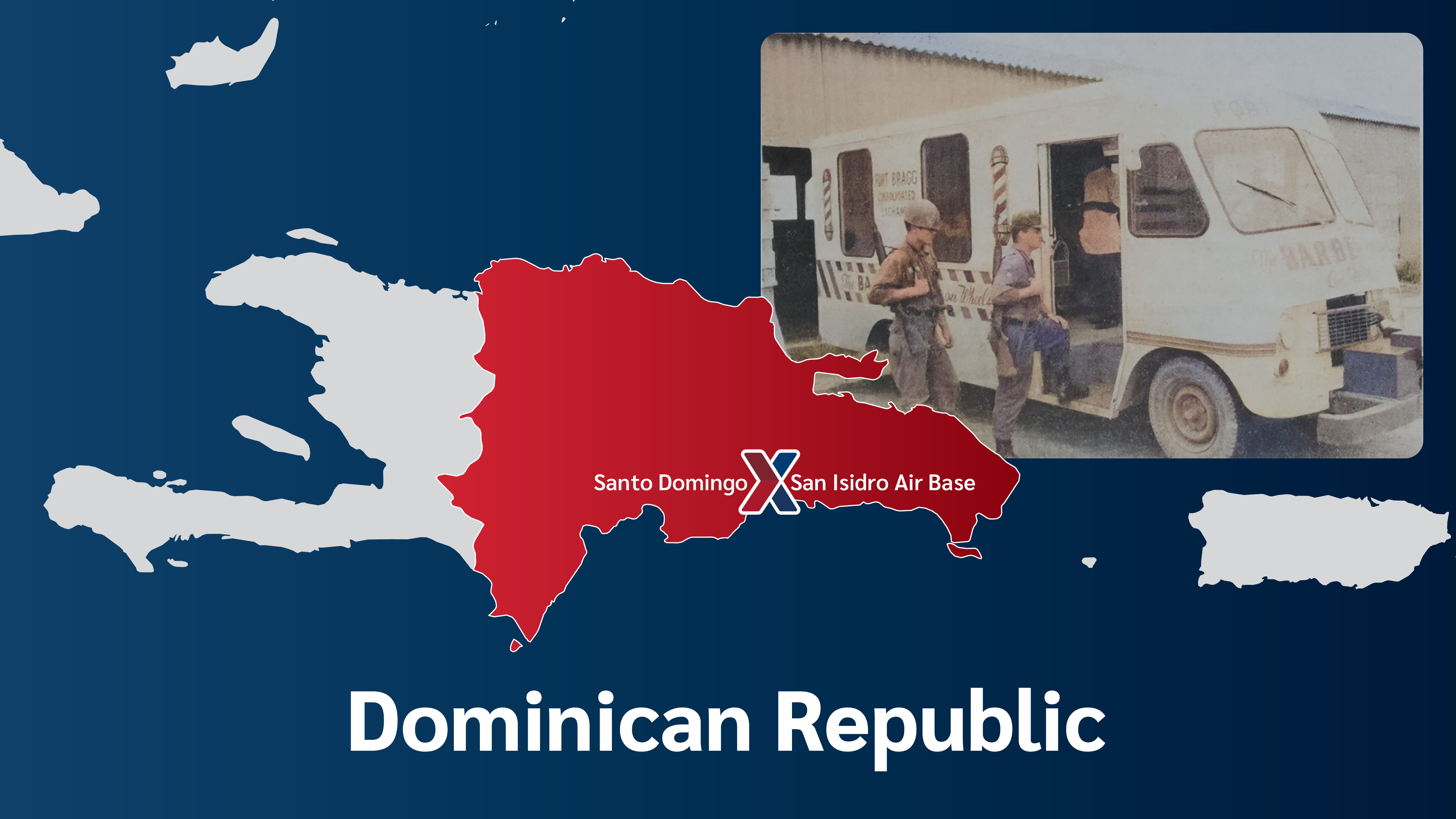

In early May 1965, U.S. forces were sent to the Dominican Republic to protect U.S. citizens after an April 24 coup led to a civil war. By May 7, 61 years ago this week, the Exchange was supporting troops by opening a field PX at San Isidro Air Base in the capital city of Santo Domingo.
The field PX was set up as a branch of the Fort Bragg Exchange, with Maj. Wilson A. Landry, assistant Exchange officer at Fort Bragg, heading the operation. Landry was assisted by Lt. Charles Fifer as well as three civilian volunteers from the Fort Bragg PX.
The field Exchange consisted of a store and a warehouse at San Isidro, and six imprest fund unit exchanges in the U.S.-protected zone. Local residents were employed as salesclerks, barbers and laborers. Like the Soldiers they served, associates ate C rations and slept in bed rolls.
The Exchange’s Southern Service Center in Atlanta provided guidance and technical assistance. Needed merchandise was shipped from Fort Bragg with some essential items sent from Ramey AFB Exchange, Puerto Rico.
Things could get chaotic, as Army Lt. Col. (R) John F. Manning wrote 30 years later in the July 1995 Exchange Post. (Manning, who was the Fort Bragg retail manager at the beginning of the Dominican Republic mission, retired from the Exchange in 1981).
Manning wrote that when Landry arrived with supplies for the unit Exchanges, the assortment fell short of what was needed—and the Army couldn’t spare the troops necessary to run the Exchanges.
Landry asked Fort Bragg GM Neil “Mac” McNeil, a former Army lieutenant who had led a cavalry platoon across Europe in World War II, for help.
McNeil asked Manning to put together a team to assist Landry. The team drew gear from the Fort Bragg Exchange and Quartermaster store. On May 8, which happened to be Mother’s Day, they endured numerous flight delays before departing for the Dominican Republic. They arrived in pouring rain, and made their way to logistics headquarters—a small airplane hangar stuffed to the roof with tons of beverages and unopened supplies.
“By 0900 [the next day], we had our store open with a full line of merchandise,” Manning wrote. “Pallets were packed and marked according to USAF specs, but someone took all the packing lists off the boxes as they were loaded into the aircraft. Every hour was like Christmas morning, every pallet unloaded a surprise. It is impossible to adequately describe what we faced those first days.”
One morning, Manning wrote, a runner from the plane-unloading detail asked if there was a consignment of milk due. The Exchange officials said no, but milk could be stored in a van until the unit that ordered it showed up. When no one claimed the milk, the Exchange officials decided that anyone who bought anything from the Exchange would have to agree to take some milk back to the squad.
“About the same time, we ran out of change,” Manning wrote, “and turned to using candy bars as change, with an extra bit of milk to round out the process.”
A few months later, a bigger deployment happened, as the Exchange began sending civilian associates to Vietnam to support troops. Some of the lessons learned in the Dominican Republic mission were applied in Vietnam.
“Although national policy often dictated the way things were done [in Vietnam],” Manning wrote, “It was from Dom Rep that us little guys learned to operate an Exchange at the mid-Soldier level.”
Sources: Exchange Post archives; “One Hundred Years of Service: A History of the Army and Air Force Exchange Service” by Col. Carol Habgood, U.S. Air Force (retired) and Lt. Col. Marcia Skaer, Air Force.

Share your thoughts!