
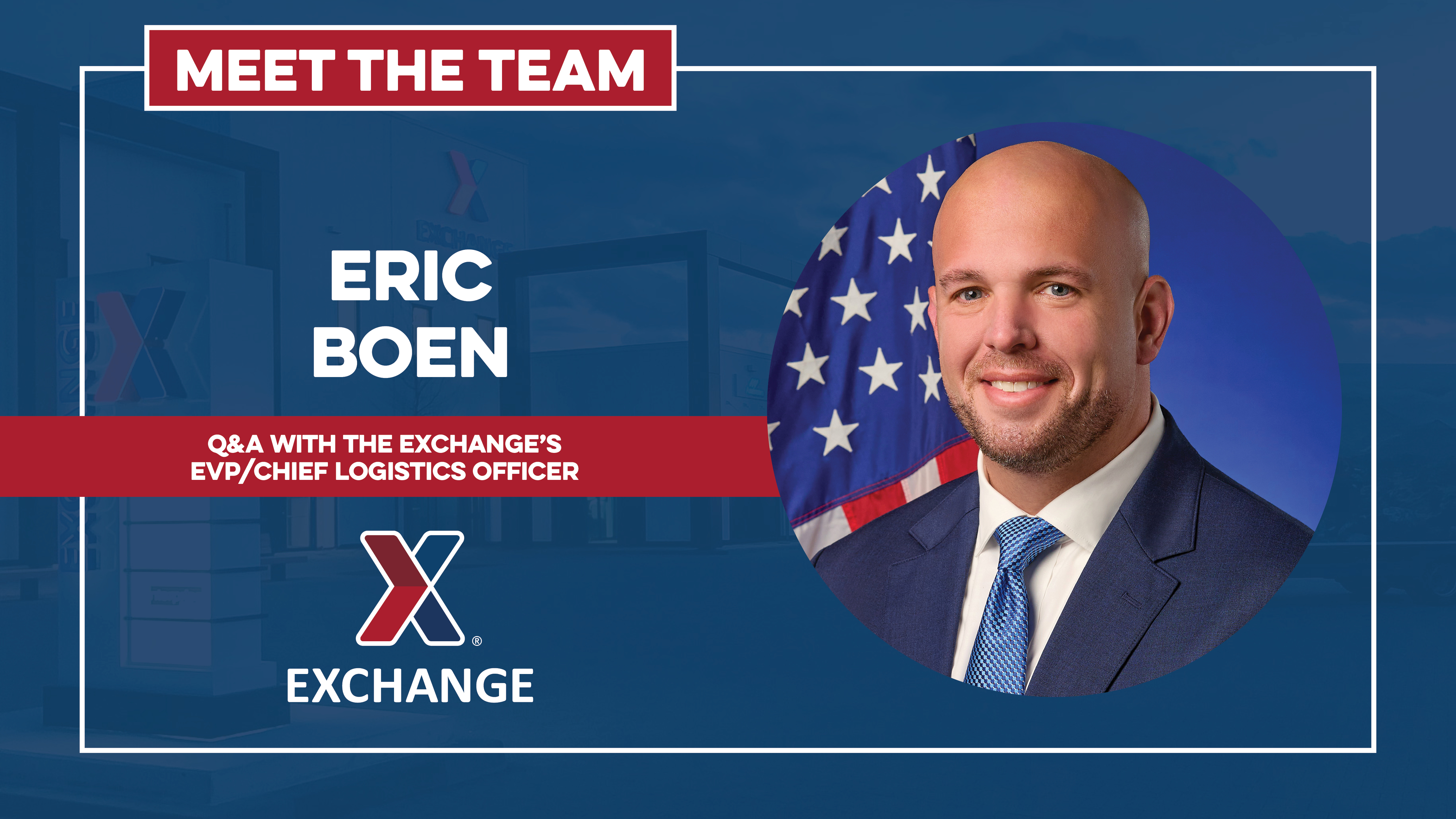

Less than a year after he joined the Exchange in 2002, Eric Boen deployed to Iraq. He was 22 years old, working as a temporary accounting assistant, and he’d heard good things about the deployment experience.
“I’d never been out of Texas at that point,” said Boen, who was named executive vice president/chief logistics officer in January. “I hadn’t even been on an airplane. The first flight was to Atlanta and then we took a prop plane to Fort Benning [before going overseas]. So my first airplane experience involved a prop plane.”
At Camp Speicher in Iraq, Boen found his niche. He began learning quickly about inventory management and supply chain management—because he had to.
“I was the team leader, basically a store manager,” he said. “I learned how to place a reorder and think about lead times. You need to order weekly, but understand it’s going to take you 120 or 180 days sometimes to get the inventory there. So I became really interested in supply chain management because I needed to get inventory in my stores.”
He returned to Dallas in September 2004, then deployed again from May 2005, serving at Southwest Asia installations until April 2008. After a few more months in Finance & Accounting at HQ, he moved to merchandising as a buyer and then to the Planning, Allocation and Replenishment (PAR) team. He became vice president of PAR in 2018, then SVP in 2022 before being named to his current role.
The Exchange Post spoke to Boen about his career and where the Logistics directorate is headed.
What exciting things are ahead for Logistics?
We’re continuing efforts to optimize the supply chain. The previous CLO had really focused on reducing expenses and driving efficiencies and attempting to modernize as much as possible. He also launched our goods-to-person effort and made sure we got into that at Dan Daniel. We’re looking into further optimizing goods to person this year.
We have autonomous mobile robots, which we’ve used extensively in eCommerce for years. We’re looking at autonomous pallet movers. So we’re going to take greater advantage of robotics.
Technology is moving very quickly with AI, and we’re leaning into it. We’re using AI to build internally where it makes sense, and we’re rethinking how we evaluate vendor technology against what we can stand up ourselves. The pace matters—we’re moving deliberately, but we’re moving.
Since 2019, we’ve been in a buying alliance with sister exchanges and the Defense Commissary Agency (DeCA). When we do joint buys, we bring the product into our distribution centers. We’re also exploring whether we can assist DeCA by replenishing some of its inventories out of our distribution centers.
Moving from SVP of PAR to chief logistics officer seems like a natural transition. How has the adaptation process been?
It’s a natural fit from just a pure understanding of supply chain.
But there’s a lot I don’t know about logistics. I am not a fan of leaders who come in and immediately enact change. I prefer listening vs. talking. You need to ask questions, listening to get the answer and not trying to get the answer that you want, but whatever the truth is.
You can make noticeable changes in your work area. People say, OK, something’s different. Once people start to understand the new expectation, you can come in and start asking other questions. I really have to understand what’s going on at the ground level and get in the weeds to fully grasp the situation. A lot of times you’ll notice the more you talk, the more honest answers get. And that’s great because that’s what you want to hear.
You deployed twice. How did that influence how you do your job today?
Because of my deployments to Southwest Asia, I’m always thinking about how to manage long lead time locations. We have by far the longest lead times of any retailer from a fulfilling-our-stores perspective.
I think as a supply chain professional, unless you’ve lived that on the store side, on the receiving end, then you don’t fully appreciate how challenging it can be. So I think it’s good for everybody to get the experience of working on the store side.
It’s very rewarding to deploy. You should if you can, because you get to fully understand what it’s like outside of the Continental United States.
What were some of the rewards?
My first site was Camp Speicher. At that point, we didn’t have a ton of sites. Troops would come in, and all they’d been eating for a month was MREs. So every time we had something like Cheez-Its available, we couldn’t keep it on the shelves. If you had Cheez-Its or Gatorade or anything that reminded service members of home, they just thanked you so much.
If you had a DVD from the latest movie back then, they were just so excited to get that and so, so grateful for you being there. We’d get magazines in and we wouldn’t even put them on the shelves. We’d just put them on the floor and cut the plastic off because they weren’t going to last anyway.
What do you do in your free time?
My wife and I have two kids, Noah and Eden, and they take up a lot of my free time. My daughter started playing basketball two years ago, so now I watch a lot of middle school basketball, and I’m about to be watching middle schoolers running, because she’s also in track. I watch my son do jujitsu and play Roblox. When I’m not doing that, I try to read. I’m currently re-reading “Good to Great: Why Some Companies Make the Leap … and Others Don’t.”
What does family serving family mean to you?
To me, family serving family is the foundation of who we are at the Exchange. It reflects that we are not just supporting a mission, we are part of the same community we serve. Many of our teammates have worn the uniform, supported those who have, or are family members themselves, which creates a level of understanding and commitment that goes beyond a typical organization.
In Logistics, this shows up in how we operate every day. Whether we’re moving critical goods to remote locations or ensuring shelves are stocked for our service members and their families on the homefront, we approach it with a sense of personal responsibility. It’s not transactional, it’s taking care of our own.
That mindset drives us to be more responsive, more resilient and more focused on doing the right thing, because at the end of the day, we are serving people who are serving the nation.



Share your thoughts!