
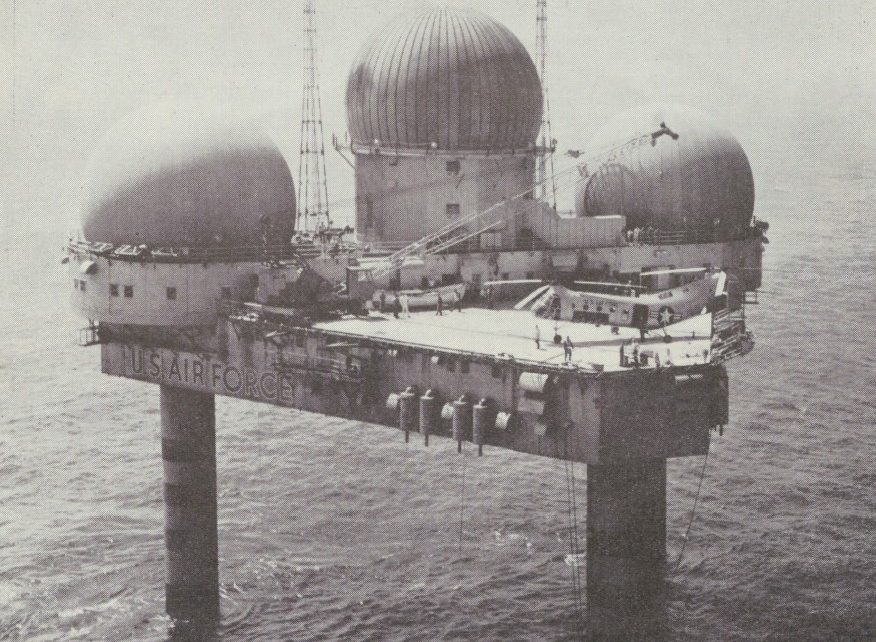

During the mid- to late 1950s, three giant radar towers were erected on the continental shelf 30 to 100 miles off the northeast coast of the United States. The towers, which operated until the early ’60s, filled in a gap in the North American early-warning system during the Cold War. Despite their location, they were nicknamed the Texas Towers because of their resemblance to oil rigs in the Gulf of Mexico.
And, in one of the more unusual examples of “We go where you go,” the Exchange was there.
A January 1959 Exchange Post story reported on a store in an 8-by-10-foot room on one of the towers, 100 miles from the mainland. The store served nautical Airmen for the North American Air Defense Command (now the North American Aerospace Defense Command, or more familiarly, NORAD).
Under the supervision of a parent Exchange at Otis AFB (now Otis Air National Guard Base) on Massachusetts’ Cape Cod, the tower BX was similar to other Exchange outlets at Airborne Early Warning Control sites.
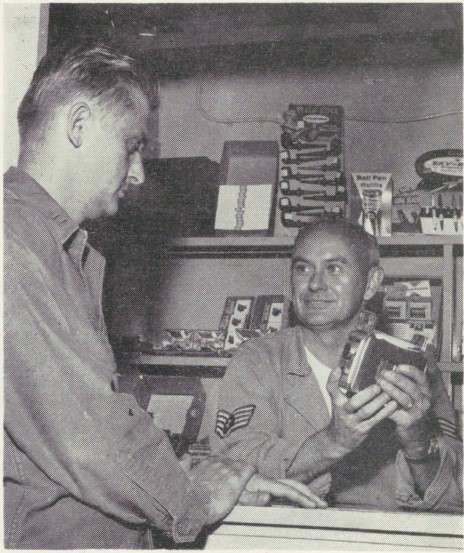
The size and the location weren’t the only unusual things about it—it was managed by the tower medic. “Besides being kept busy providing medical service and running the Exchange, in some cases, when he has enough rank, the medic acts as noncommissioned officer-in-charge of the tower,” the story said.
With a rotation every 30 days between the tower and shore station, the medic/manager had to take a complete stock inventory before his departure. He also had to fill orders and stock shelves for his successor.
The tower Exchange typically carried items such as cigarettes and tobacco, shoe polish, toothpaste, jewelry, luggage, cameras and photographic equipment and more. Other items could be ordered from the Otis Exchange. All food and supplies were delivered via ship from New Bedford, Massachusetts, weather permitting.
Texas Tower duty was rough. It was considered a two-year, isolated area, overseas tour of duty. One year was spent aboard the towers in alternating 30-day periods. The towers swayed and rocked in heavy seas, and according to a Life Magazine story, were so noisy that crewmen who rotated ashore “found the silence of their own homes so unnerving that they were forced to play a radio … to get to sleep.” According to the Exchange Post story, the Exchange’s presence on the tower boosted morale in those uncomfortable conditions.
It’s unclear exactly when this unique chapter in Exchange history ended. But during a gale in January 1961, one of the towers, already damaged by a hurricane the previous year, collapsed, killing 28 people aboard. The last tower was shut down in 1963.
Sources: Exchange Post archives, The Air Defense Radar Veterans’ Association (https://www.radomes.org/museum/documents/TexasTower.html); “Texas Towers Await the Wreckers” by Evan McLeod Wylie, Life Magazine, June 26, 1963; Joint Base Cape Cod website (https://www.massnationalguard.org/JBCC)



Share your thoughts!