
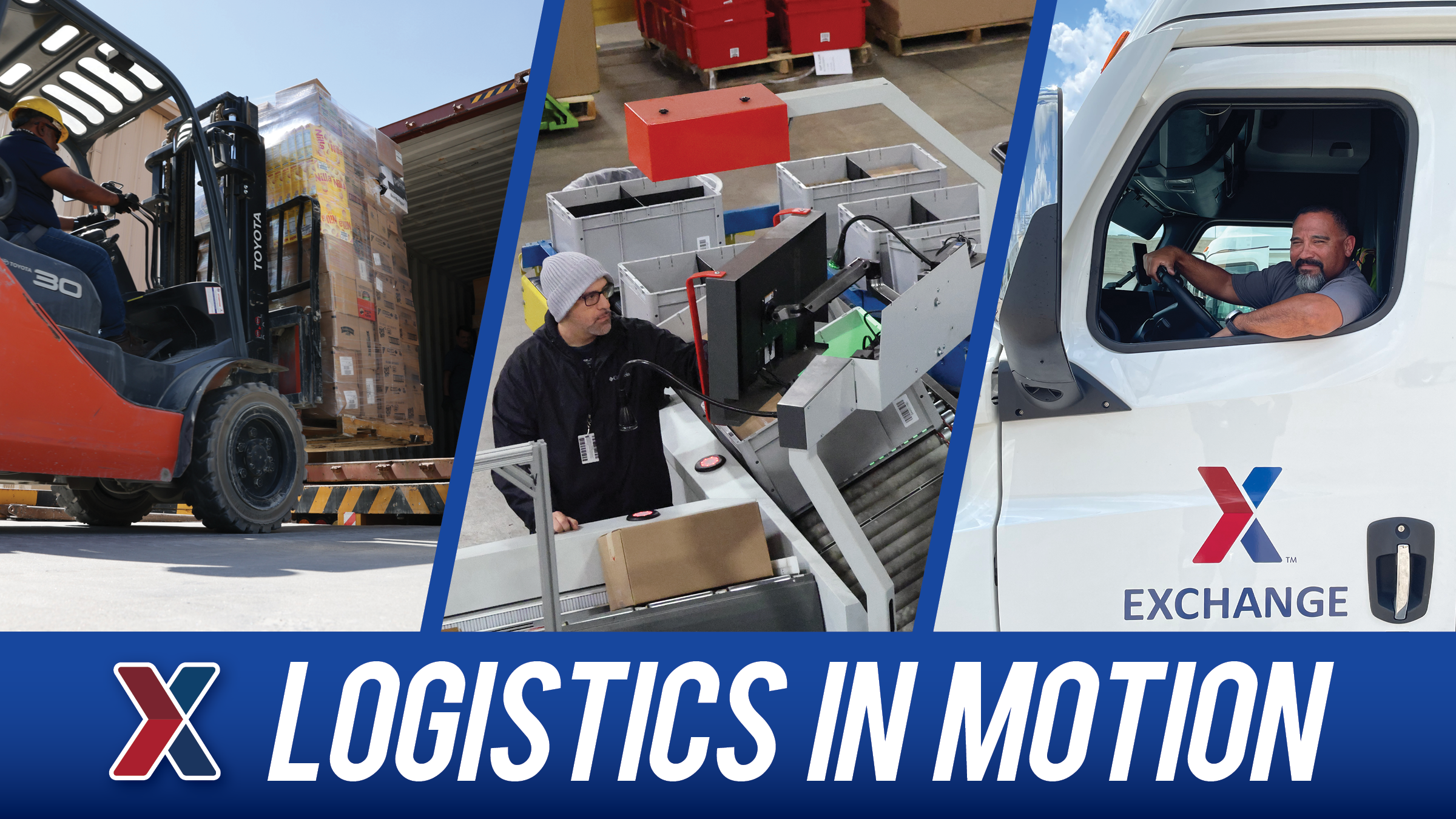

When most people think of the Exchange’s Logistics Directorate (LG), they picture warehouses, pallets, mobile field Exchanges (MFEs) and delivery trucks. While those are certainly part of the mission, they represent a fraction of what LG delivers every day. Behind the scenes, LG is a global, precision‑driven operation that ensures the right products reach the right places at the right time—supporting our Nation’s heroes and families worldwide.
“At its core, LG is responsible for far more than moving merchandise,” said Exchange EVP/Chief Logistics Officer Eric Boen. “The directorate oversees imports and trade compliance, supply chain analytics, contract negotiations, transportation operations, contingency planning and more.”
LG is led by Boen and supported by Supply Chain Senior Vice President retired Army Col. Fred Hannah and by Logistics Deputy Director Col. Emanuel Velez. Together, they guide a worldwide team of associates across HQ, three CONUS and six OCONUS distribution centers, keeping the Exchange’s supply chain strong, agile and mission‑ready.
High‑volume meets high tech
“Overall, there are 1,645 associates within the Logistics Directorate committed to providing an efficient supply chain. This includes our Facilities Management Operations team that maintains equipment and buildings, purchases company vehicles and equipment for stores and DCs and closely collaborates with Loss Prevention to ensure our network operates safely and efficiently,” said Logistics Vice President Morgan Meeks. “Throughout the distribution centers, associates are dedicated to shipping more than 40 million cases of merchandise annually.”
With demand that high, LG doesn’t work alone. The directorate partners closely with the IT team to implement technology to keep the Exchange competitive and evolving, including voice picking headsets and the goods-to-person automation system, which began at the Dan Daniel Distribution Center (DDDC) in Newport News, Virginia, in 2025.
The headset guides associates directly to the merchandise they need—boosting speed, accuracy and efficiency across the DCs, while the goods-to-person automated system uses conveyors to shuttle items for orders directly to associates without the need to move within the distribution center.
Logistics in motion, mission in mind
From the DC, the Transportation team, led by Transportation Operations Vice President Jason Rakestraw takes over delivering merchandise where it needs to be.
The Exchange is the fourth largest shipper in the Defense Transportation System and exports nearly 25,000 20-foot equivalent units (TEU) annually, the standard unit of measurement for the capacity of shipping-containers. One container is equivalent to a single-car garage and each container can fit a small school bus.
“The Exchange operates 200 tractors and nearly 1,400 trailers. Exchange drivers accumulate nearly 10 million miles a year, ensuring our Nation’s heroes are equipped with essential goods no matter where their service takes them,” Rakestraw said. “Our fleet is the 15th largest private retail fleet in the U.S.”
Select drivers also take part in the fun of hauling trailers sporting head-turning wraps created by Corporate Communication designers for events and milestones including the Exchange’s 130th anniversary and the highly anticipated Army-Navy Game.
No matter when, no matter where
The Exchange goes where our Nation’s heroes go—especially in times of need. That’s where Contingency Plans Vice President Roger Neumann’s team enters the chat. Whether responding to natural disasters, military operations or large‑scale humanitarian missions, the Exchange can deploy MFEs staffed with associates to serve those who serve, wherever they are.
“MFEs typically carry an assortment of snacks, beverages and hygiene items; however, they can be tailored to meet the unique needs of the communities they support,” Neumann said. “For example, the Exchange deployed three MFEs after 9/11 to support search‑and‑rescue efforts, as well as seven during Operation Allies Welcome (OAW) in 2021 that were specially stocked with essential items including childcare items not normally carried in an MFE. OAW demonstrated our capabilities across the enterprise to offer flexible, creative solutions to patrons—and we bring those solutions to the military community worldwide.”
Intermodal links, interpersonal bonds
The Intermodal team plays a central role, coordinating, negotiating and implementing third‑party ground and air logistics contracts. Their work ensures seamless movement across multiple transportation modes—from overseas shipments to final delivery at Exchange stores. They also provide essential military insight, working closely with Air Force, Army and Space Force personnel to align logistics operations with mission needs.
“Ensuring our service members understand the Exchange’s mission is pivotal to the success of our organization,” Velez said. “Through the Intermodal team, we connect with Air Force and Army personnel to communicate that mission and strengthen our partnership.”
Recently, the team developed The Frontline Exchange, a newsletter designed to connect military personnel assigned to Exchange HQ with community resources and organizational updates.
“Logistics is about connections and that includes interpersonal connections as much as moving merchandise,” Hannah said. “Any opportunity we have to better serve our Nation’s heroes is taken, and for LG, that opportunity starts internally at the Exchange.”

Share your thoughts!