
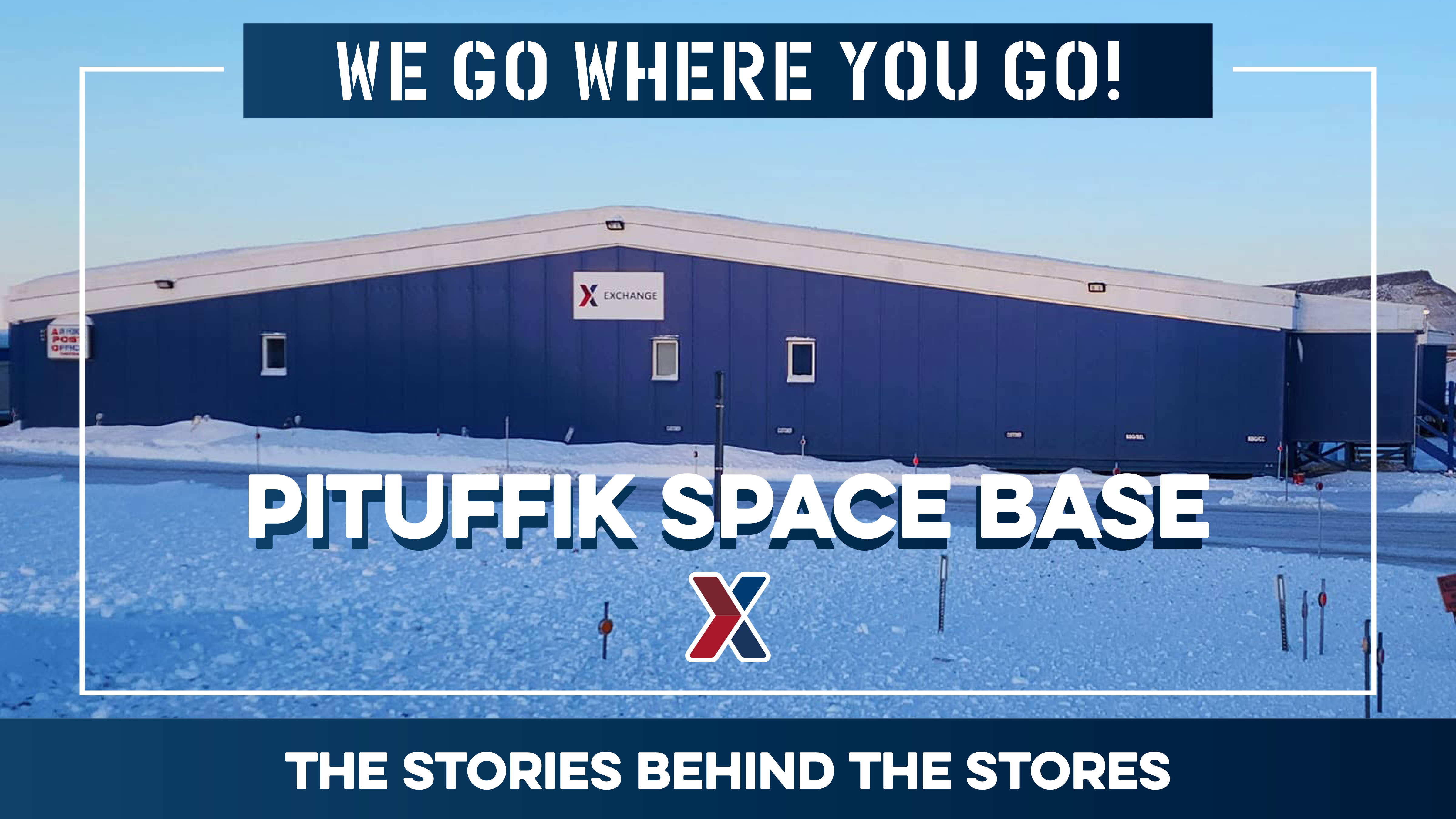

The Exchange lives up to its “We go where you go” motto with stores serving locations all over the world, from the South Pacific to the North Atlantic, from Kuwait to Korea and more.
Many of these locations are remote and unusual, even in CONUS, where branch stores serve smaller military communities. In this Exchange Post series, we look at the stories behind these stores. This installment is about the Pituffik Space Base Exchange in Greenland.
What makes the Pituffik Exchange unique: Pituffik is northernmost U.S. Department of War installation, at the “Top of the World” 750 miles north of the Arctic Circle in Greenland. For perspective, Pituffik is at 76° 32′ North latitude; the Exchange’s second-northernmost facility, in Setermoen, Norway, is at 68° 52′ North. Fort Wainwright, the northernmost Alaska Exchange, is at 64° 50′ North. Average winter temperatures at Pituffik range from 13 to 30 degrees below zero. From late October to mid-February, the base is in total “polar darkness”; from late April to late August, it’s in constant daylight.
Major units supported: : 821st Space Base Group; 23rd Space Operations Squadron, Det 1; and the 12th Space Warning Squadron.
Size of the team: Four associates
Number of facilities: One troop store
Installation history: The site’s history predates its military use, with Inuit habitation for more than a thousand years and European and U.S. exploration going all the way back to the 16th century—however, mapping of more continued exploration and settlement dates to the 19th century. In the early 20th century, explorer Knud Rasmussen established a trading post known as Thule. During World War II, the United States established a limited weather and radio presence in Greenland, laying the groundwork for postwar expansion. Following Denmark’s accession to NATO in 1949 and growing Cold War tensions, the U.S. identified Thule as a critical Arctic defense location.
Construction of Thule Air Base began in 1951 under Operation Blue Jay, a large‑scale effort completed by 1953. During the Cold War, the base became a cornerstone of U.S. strategic deterrence, supporting Strategic Air Command operations, Arctic reconnaissance flights, missile defense systems and early warning infrastructure. At its height in the early 1960s, Thule supported approximately 10,000 personnel.
From the late 1960s onward, operations were gradually consolidated as defense priorities evolved. Thule transitioned to an Air Force Space Command installation in 1982, reflecting its growing space surveillance and missile warning mission. Jurisdiction over surrounding civilian areas was returned to Denmark in the early 2000s, and force levels continued to decline. In 2020, the base was formally transferred to the U.S. Space Force, and in 2023 it was renamed Pituffik Space Base to reflect its space mission and the region’s heritage.
Today, Pituffik Space Base remains a strategically vital installation, providing persistent Arctic presence, advanced missile warning, and space domain awareness for U.S. and its allies, while operating under a long‑standing multinational defense partnership.
Store history: Post exchanges in Greenland date at least to World War II, when they were operated by the Eastern Defense Command and were the responsibility of garrison commanders.
In 1946, the Greenland exchanges and other Atlantic offshore exchanges came under the operational control of the Air Transport Command. Although it’s unclear exactly when an Exchange was first established in Thule, the September 1956 issue of the Exchange Post mentions Exchange activities in Thule. In late 1971, the Atlantic offshore exchanges were realigned under the Army & Air Force Exchange Service.
Through the decades, several BXs have supported troops throughout the base. The facility relocated to its current building in 2013. The Pituffik team participates annually in bringing supplies to the facility, using the summer ship Operation Pacer Goose.
What it’s like to live there: Living at Pituffik Space Base is a unique and demanding experience shaped by its remote Arctic location. Associates must adapt to extreme cold, harsh weather and prolonged darkness, while operating with limited amenities and connectivity. The isolation fosters a strong sense of camaraderie and mission focus within a small, close‑knit community. Despite the challenges, Pituffik offers a rewarding assignment to the Exchange team, which supports those who are supporting critical national security missions in one of the world’s most strategically important environments.
What associates can do during time off: During the summer, there are excursions, fondly known as Thule Trippin’, that include skiing, sledding, snowboarding, ATVing, climbing Mount Dundas and more. (For more on Thule Trippin’, click here.)
Exchange associates also have access to amenities, such as the gym, bowling alley, arts-and-craft room, movie theater and community center. People can attend events such as karaoke, bingo, trivia and more.
SOURCES: Exchange Post archives, 821st Space Base Group




Share your thoughts!