
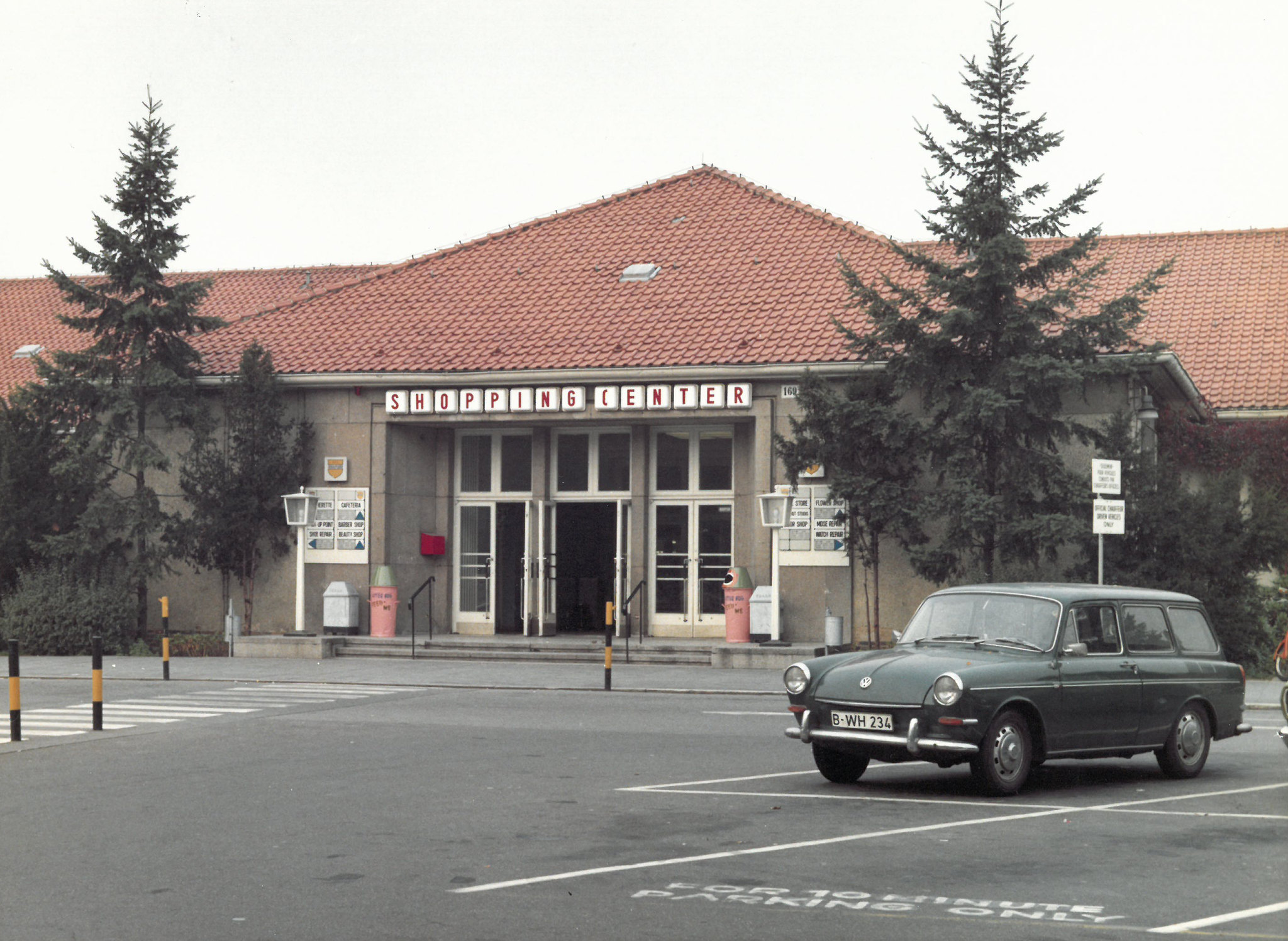

On Aug. 13, 1961—65 years ago this week—construction began on the Berlin Wall. By that time, the Exchange had operated in Berlin for more than 15 years, and it continued in West Berlin after the Cold War barrier was built. (Pictured above is the Berlin Exchange circa 1974.)
The first PX in Berlin was established a few weeks after the end of World War II to sell chocolate, soap and cigarettes. During the 1948-49 Berlin Airlift, trucks from the PX brought food and drinks to pilots on the tarmacs so they could quickly return to delivering 9,000 tons of food, fuel and medical supplies to local residents.
After construction began on the wall, President Kennedy called up thousands of troops to Berlin, and the European Exchange Service (EES) provided on-the-spot service to the U.S. Army Berlin garrison. Mobile exchange vans from EES served troops stationed at the wall.
“Aside from the fact that we operate in a highly publicized area, running an exchange in West Berlin is no different than anywhere else,” Glenn T. Ino, executive of the Berlin PX, told the Exchange Post. Ino, who had been in Europe 17 years, 15 of them with EES in Germany, rotated back to the United States just after the wall went up.
A June 1976 Exchange Post feature about the Berlin Exchange Region, which was within the 185 square miles surrounded by the wall, indicated that some things were different. By that time, nearly 400 associates worked in the region. six of those associates had been with the Berlin Exchange since it opened in 1945.
“Our AAFES Furniture Center was called on to support the furnishing of the American Embassy when it opened in East Berlin,” Berlin Exchange Region Commander Lt. Col. Robert G. Straeb, told the Exchange Post. “We regularly send merchandise to the U.S. Embassy stores in Warsaw and Moscow.”
The region also supported a free-admission movie theater at the U.S. Mission House in Potsdam, just to the west of Berlin—as well as another theater in Spandau Prison, which was used three months a year for an American guard detail that rotated with the British, French and Soviet guards.
Seven Exchange trucks a week transported the bulk of merchandise to the region via the autobahn from Helmstedt to Berlin, about 120 miles one-way.
“AAFES drivers bring the trucks from the depots as far as Helmstedt and then military drivers take over for the trip through the ‘zone,’” Straeb said. “Each vehicle is classified as a convoy so our trucks leave in one-hour intervals behind a military convoy or another Exchange vehicle.”
During President Reagan’s 1987 visit to Berlin—where he famously urged Soviet Premier Mikhail Gorbachev to “tear down this wall” during a speech at the Brandenburg Gate—the president spoke to an audience of U.S. service members and their families during a celebration of the 750th anniversary of Berlin’s founding. Some of the food at the celebration was provided by the Berlin Exchange Burger King, which served Whoppers, coleslaw and potato salad to 2,000 people.
With the fall of the wall in 1989 and the collapse of the Soviet Union in the late 1980s-early 1990s, many of the Cold War-era installations and their exchanges closed. The West Berlin Exchange closed sometime in the early ’90s.
Today, the Army & Air Force Exchange Service operates more than a dozen stores and facilities in Germany. The closest modern Exchange to Berlin is in Wiesbaden, more than 350 miles away.
Sources: Exchange Post archives, Exchange History Flickr.



Share your thoughts!