
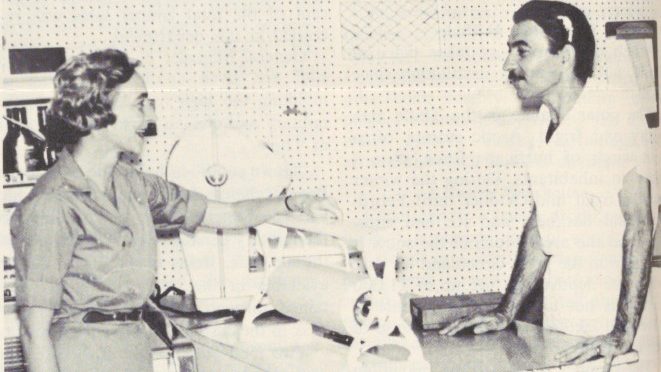

One of the more unusual PX locations in Exchange history was in Rio de Janeiro, Brazil, where a small PX opened in late 1949 to provide services to authorized personnel of the Joint Brazil-U.S. Military Commission (JBUSMC).
The store—which had a 20-foot-by-60-foot sales floor—served as Exchange and commissary not just to the JBUSMC but to other U.S. military advisory groups working in Brazil, Argentina, Uruguay and Paraguay. It also served Brazil-based U.S. State Department, U.S. Information Service and Central Intelligence Agency employees.
The PX wasn’t on a military installation. “Our Exchange is a walled compound between downtown Rio and the airport,” William John, the PX’s general manager in 1963, told the Exchange Post. “It’s not a nice suburb.”
Among the store’s challenges were frequent power outages. Outdoor temperatures could reach as high as 106 degrees in December, Brazil’s summer. Meat needed to be bought in advance in the early ‘60s, because at the time it was rationed in Brazil and not available on Mondays or Tuesdays.
One of the store’s most popular items was soy milk, which was originally stocked for a few American children who were allergic to dairy milk. The allergy turned out to be common among Brazilian babies, so when parents with sick babies in Rio heard about the PX’s stock, arrangements were made for the State Department to provide the soy milk to those Brazilians.
In 1966, the Rio facilities were upgraded with new fixtures and more modern equipment. The stock assortment was expanded to offer customers a wider variety of U.S. retail and food items. The PX also had a butcher shop—believed to be the only one in the Exchange system at the time.
According to a 1969 Exchange Post story, the Brazil Exchange team included only two Americans—the general manager and the retail manager. The rest of the 45-member workforce included Brazilians, but the majority of associates were immigrants from Poland, Portugal, Belgium, Holland, England, Germany, Russia, India, China, Egypt, Uruguay and Paraguay.
“The Brazil Exchange is at times called the United Nations Organization,” said Joseph C. Lima, the general manager in 1969. “This healthy mix of Brazilian nationals and foreign personnel enables the JBUSMC Exchange to display a tremendous amount of professionalism in carrying out its mission.”
Lima said that a couple of years earlier, the warehouse was plagued with a rat problem, which was solved when Ze Roberto, Mimi and Nora—three cats—were added to the mix. Lima estimated that the cats saved the Exchange $3,000 a year (equivalent to more than $27,000 today) in losses.
The Rio de Janeiro Exchange closed in March 1978. Although the Exchange has supported humanitarian missions in South America, including in Peru in 2008, the Rio Exchange was the last brick-and-mortar PX in South America. The closest Exchange to Rio today is the Fort Buchanan Exchange, more than 3,200 miles away in Puerto Rico.
SOURCES: Exchange Post archives, “One Hundred Years of Service: A History of the Army and Air Force Exchange Service” by Col. Carol Habgood, U.S. Air Force (retired) and Lt. Col. Marcia Skaer, Air Force

Share your thoughts!