

If things had started on time, Bob Ellis might not be around to talk about it today.
On Sept. 11, 2001, Ellis, then the Exchange’s Washington Office director, was scheduled to have a 9 a.m. meeting at the Pentagon with the Army’s Morale, Welfare and Recreation team. When it hadn’t started by 9:30, Ellis left.
“As soon as I walked out the front door of the Pentagon, I heard the sound of an aircraft or a cruise missile whining,” said Ellis, now vice president, Exchange & Member Relations for the American Logistics Association and an accomplished pilot. “I’m familiar with jet sounds, and I could hear it thrusting up.”
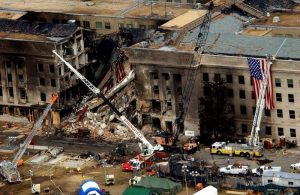
Seven minutes after Ellis left the meeting, American Airlines Flight 77 slammed into the Pentagon, hitting the room that he had been in.
Earlier, Ellis had been in his Crystal City office, close enough to the Pentagon that he could see the complex from his office window. The World Trade Center had already been attacked. Ellis’ executive assistant had warned him against going to the meeting. “She actually said, ‘Bob, you know the Pentagon is next’,” Ellis said.
Nearly two dozen people were still in the meeting room when the plane hit. One was Lt. Gen. Timothy Maude, the highest-ranking U.S. military official killed in the attacks. After Ellis left the meeting room, his executive assistant was on the phone with Maude’s secretary, who said, “Oh my God, there’s an airplane.”
And then the call cut off.
A beautiful day, then terror
Earlier that morning, Steve Williams, the retail manager at the Fort Hamilton Exchange in Brooklyn, had driven across the Verrazano-Narrows Bridge on his way to work. “The sky was clear blue,” he said. “That was the clearest day I remember from New York City.”
Williams also had a meeting, to discuss a just-started store renovation. Right after the meeting began, his assistant told him a plane had hit the World Trade Center. “I thought a tourist plane had gone off course or had mechanical problems,” said Williams, now president of Ranger Logistics Co. “I didn’t think it was an attack. A few minutes later, she came back in and said, ‘Mr. Williams, another plane hit the World Trade Center.’ That’s when I realized it was an attack.”
Williams and others in the meeting went to the Exchange’s barbershop to watch TV coverage. Within moments, he got a call from the post commander.
“He said, ‘We’re going to go to Delta,’ which is total lockdown,” Williams said. ‘‘I need you over here for a meeting in about 10 minutes. I need to know much fuel we have on the ground, how much water, how much milk. Don’t dispense fuel to anybody except an emergency vehicle. And that’s only on my orders.’
“I was surprised how quickly he called me,’’ Williams said. “That’s how important the PX is to the community.”
Burning boots
Back at the Pentagon, Secretary of Defense Donald Rumsfeld’s bodyguard walked up to Ellis with a note from Rumsfeld. “It said, ‘These are the things that we’re going to have to take care of here’,” Ellis said. “I sat there and designed a plan.”
He immediately knew one item he would have to place a large order for.
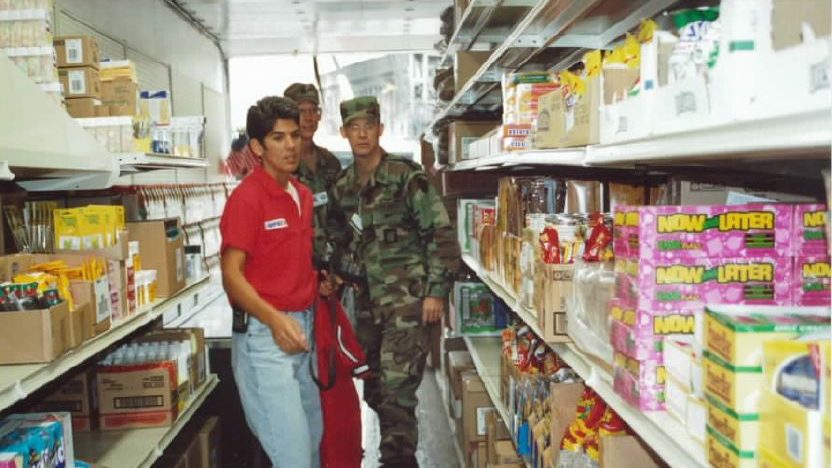
“The firefighters’ boots were literally melting, instantly, on the floor and in the debris. Within a day or so, we had a truckload of Bates boots,” he said, referring to a brand made for military and first responders. “We also had truckloads of Gatorade. Every area manager in the Washington, D.C., area came to me and wanted to know what I needed. We emptied the stores of things like towels and linens and eye wash.”
Beth Goodman-Bluhm, then the store manager at the Andrews Air Force Base Exchange, had been having a normal morning on 9/11 preparing to open the Main Store. Then someone in the breakroom indicated something was going on in New York City, so the team went back to the breakroom to watch the events unfold live on TV in disbelief.
“Shortly after the second plane hit the tower in NYC as we watched live on TV, we realized this was a real-world event and we weren’t sure if we were all safe inside the building,” said Goodman-Bluhm, now East Central Region Vice President. “The base quickly went to Delta and we sent our Associates home that weren’t needed elsewhere to support the Express.
“Many of the Associates ventured outside to see what was going on,” she added. “It was sad, we heard and saw the military jets taking off. It wasn’t until a bit later we realized that the Pentagon was also hit. We were going, ‘What’s next?’ Everybody was in shock. We gathered up and headed home.”
Goodman-Bluhm picked up her young daughter from school and was soon back to work, as the Exchange arranged for two tactical field exchanges to be set up at the Pentagon.
“Our role was gathering associates,” she said. “Between all the Beltway stores, there wasn’t a shortage of Associates volunteering to work when that mobilization took place. We were ready within 48 hours. We had a list of associates ready to volunteer to work the Mobile Field Exchange 24/7. We had so many volunteers working their shifts at the store then wanted to volunteer to work at the MFE as well. The entire team of senior leaders and Associates who played a part in support of the Pentagon was epic and heartfelt. Truly a team effort.”
Family serving family – and becoming like family
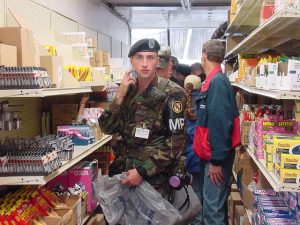
Theresa McDonald, who worked in Loss Prevention at the Andrews Exchange, had left home after the first plane hit the World Trade Center but thought the attack was just an accident. It wasn’t until her son called her that she found out about the second plane or the attack on the Pentagon. She wouldn’t return home for 2½ weeks.
“All facilities were locked down except for the Express, and the Express was ID-card only,” said McDonald, who has worked at Andrews since 1999 and is now regional Loss Prevention manager. “So I wrote an IOU, got two pairs of jeans, two AAFES shirts and some underwear. I ended up staying on base with one of my LP teammates.”
McDonald went to the trailer at the Pentagon every afternoon and stayed all night. Every night, she blasted Lee Greenwood’s “God Bless the U.S.A.” and people nearby sang along and cheered.
“Search and rescue folks, with their dogs, would come and hang out with us every night,” McDonald said. “We became close because it was such an awful time. One of the associates was very talented in sewing, and we made collars and knitted scarves for the dogs. Soldiers who were helping clear out the Pentagon would come by. We had a lot of merchandise so they would always have clean socks, underwear, T-shirts, snacks and food. I don’t think people realize how much everybody became family on that site.”
(To read a thank-you letter from a task-force member to McDonald, click here.)
‘The only normal thing’
After learning of the attacks, Williams’ first concern at Fort Hamilton was the store staff. “We had maybe 80 workers,” he said. “Some of them had relatives in the World Trade Center. Right away, our phone lines jammed, so nobody could get through on the phone.”
Williams wasn’t able to talk to his wife, who worked in Midtown Manhattan, until the late afternoon. He wouldn’t see her or his son or daughter for about two weeks.
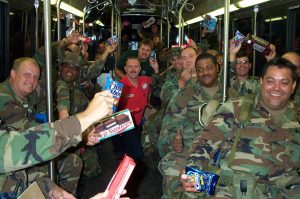
When he returned from his meeting with command, Williams gathered associates and told them what he knew. “We calmed down the employees and found out who had relatives in the World Trade Center,” he said. “It turned out that none of the family members at the World Trade Center got killed or hurt.”
The National Guard was setting up in Battery Park, on the southern end of Manhattan, not far from the World Trade Center site. As Williams and Area Manager Ray Black drove to the Guard site, they passed debris from the towers. At one point, Williams saw five crushed fire trucks stacked atop one another.
“There were a million papers everywhere,” Williams said. “In all the debris, there was nothing else to indicate that the towers were office buildings. I didn’t see a part of a desk. I didn’t see a calculator. I didn’t see a chair. Everything was just ground down to this gray dust.”
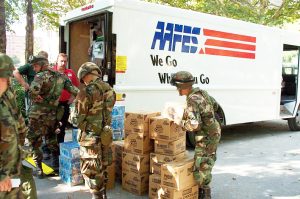
The next day, Williams, Black and then-West Point General Manager Allan Heasty started preparing for the arrival of a mobile field exchange, which was in Battery Park by Sept. 13. Vendors donated merchandise in support. Another MFE was set up on Park Avenue. A mobile truck visited National Guard armories in New York City. The Battery Park operation moved to Governors Island, a New York Harbor site with a long history of being home to military installations. A temporary PX was set up inside one of the buildings.
The team also worked at the World Trade Center site. “That was probably the hardest thing I’ve ever done in my life,” Williams said. “We’d walk through crowds of people, of families. To see sons and daughters and mothers and fathers grabbing at you and saying, ‘Sir, have you seen this person?’ And they’d hold up a picture. It was heartbreaking.”
As at the Pentagon MFE, Guard members, Soldiers and first responders would stop by just to talk.
“We were the only normal thing going on in the area,” Williams said. “I talked to people doing recovery. You’d say to someone, ‘How are you doing?’ and they might be very quiet. Then they’d say, ‘It’s been a rough day – I found two more bodies. That could’ve been me down there.’”
An Exchange-wide team effort
The Exchange kept the MFE at the Pentagon running for two months. Trucks from the Dan Daniel Distribution Center made daily trips to Pentagon and New York to supply merchandise.

“We had such a great team from the entire Beltway,” Goodman-Bluhm said. “It wasn’t just Andrews. It was Fort Myer, Bolling … the entire Beltway team pulled together. Most of the folks that worked at the MFE were from Andrews, but 24/7, around the clock, it was open.”
Williams had a similar experience in New York, where the mobile exchanges were running for about three or four months – but it took things longer to slow down for him.
“I worked straight through for seven or eight months,” he said. “All the different stores were already helping with the Fort Hamilton renovation, so they all wanted to do their part and help out after 9/11. They’d work the mobile truck and sometimes come to help out at the PX on Governors Island.
Ellis still calls it the Exchange’s finest hour.
“The stores played a big role in support after 9/11, not only in Washington and New York, but around the country,” Ellis said. Exchange associates from around the world donated blood, held fundraisers and sent messages of support. Associates from throughout CONUS volunteered to help out in the East.
“I don’t know how we did what we did, but the Exchange has a capability that’s beyond what anybody realizes,” Ellis said.
Read more: Exchange Inspector General VP Shares 9/11 Memories from His Air Force Days

Share your thoughts!