

Long before Dr. Patrick Oldenburgh Jr. was the Exchange’s Chief Human Resources Officer, he accompanied his mother to the Bindlach and Amberg Exchanges in Germany, where she was a theater supervisor. She would bring him and his sister to the theaters, where they would sit in the projection room while she worked.
“This was back in the day when we had arc projectors,” said Oldenburgh. “That fascinated me as a kid, how this one little copper rod inside of the projector could bring the movie to life.
“And as I got a little older—I’m talking 8 or 9—I would go downstairs and sit in the theater after the movie started. I remember sitting there as a kid watching ‘Friday the 13th’ in the theater. I had nightmares when I went home that night, but it was great.’ Oldenburgh continued, “I used to joke with my mother that she would have to see me in HR these days, as bringing you children to work is frowned upon.”
That did not scare him off from a long career at the Exchange. His more than 30 years of service will come to a close when he retires in July, the final chapter in the Oldenburghs’ Family Serving Family story—his father and sister also worked at the Exchange.
Growing up in Germany
Oldenburgh grew up in Amberg, in what was then West Germany, where his father, a proud Army Soldier, ran the retail stores at camps along the borders with East Germany and Czechoslovakia during the Cold War.
“I remember hearing stories from him where protestors from Czechoslovakia and Hungary would make their way into Germany, challenging the Warsaw Pact,” Oldenburgh said. “The U.S. troops would point their guns at the Soviet troops, as if to say ‘Don’t fire on the protesters or we’re going to fire on you.’ I remember him talking about how tense it was along the border at that point in time.”
Then the Berlin Wall fell, and borders began to open as the Soviet Union started to weaken.
“I was with a group of friends, going down to our local hangout in downtown Amberg, and [the fall of the Wall] was on the news,” he said. “And then there was this big celebration. Everybody was coming out to the streets and cheering and yelling and hollering. It was a pretty significant historical moment and it was pretty neat to be able to experience the news with my German friends.”
As a teen, Oldenburgh delivered papers for Stars and Stripes, picking them up at the Amberg Exchange bookstore. As he grew older, he began looking for a job that paid more and didn’t require him to be up at 4 a.m. He applied for a job at the Vilseck food court, and worked at Frank’s Franks, an Exchange-exclusive hot dog stand.
When a sales associate job opened at the Amberg Shoppette, Oldenburgh jumped on it. His parents had to drive him to his Vilseck job, but this one was closer to home.
The Amberg position was part time, so when a full-time supervisory job came up, Oldenburgh applied. The Exchange Manager liked his work, but she had other ideas about what he should do.
“Leah Ross, who was our Exchange manager, said, ‘Here’s the deal, Patrick. I would hire you in a heartbeat for this position. You could do this job easily and you’d be very, very good at it. But I think you need to go back to the States and get your degree. I think that’ll be better for your career. Just focus on your education, get that taken care of. And then if you want to come back to the Exchange, you can come back in as a college trainee. Just make sure you take care of yourself and put your education first.’”
He was disappointed—but took her good advice.
Coming to America
Oldenburgh returned to the States, majoring in speech and communication at Cameron University in Lawton, Oklahoma, eventually returning to the Exchange at Fort Sill.
“I went to college, then came back, then left, and then left again,” he said. “It was during that second iteration, when I was working at the Sheridan Road Shoppette at Fort Sill, that an opportunity arose.”
Oldenburgh had been working part time for about two years when, in 1996, the Fort Sill training instructor retired. Sheila DuBois, the Fort Sill HR manager, thought that with Oldenburgh’s college background in speech, debate and communication, he would be a good fit.
“She asked if I would be interested in trying out for the training instructor job and I said, ‘Sure, why not?’ And she said, ‘OK, you’re going to teach a class next Saturday. The Art of Customer Service.’ I said, ‘OK, great.’ And she said, ‘Here’s the material. See you next Saturday.’ And she just dropped the material on the register.”
Oldenburgh enjoyed the experience and wanted the job. But there were delays, and he didn’t hear anything more about the position. He was close to graduating, he liked the Exchange, but wanted something new. He volunteered to deploy to the Balkans, where the Exchange was supporting peacekeeping troops during the late ’90s.
“After I volunteered, Sheila came running over and said, ‘You can’t deploy! I’m about to promote you! You need to decide now. Do you want to deploy or do you want a permanent promotion?’ I wanted the permanent promotion. And so that’s when I became a training instructor.”
9/11 and deployment
After a few years, Oldenburgh moved to Buckley AFB (now a Space Force base) in the Denver area, where he was Human Resources manager. He was at Buckley when the 9/11 attacks happened.
“I was getting ready for work and watching TV when the first plane hit the first tower,” he said. “I thought, ‘Oh no, that’s unfortunate. What a terrible accident.’ Then, as I remember, I was making breakfast and I heard the second plane hit. Right after that, the GM called and said, ‘I need you at the base right now. If you’re not here in 20 minutes, you’re not getting on the installation.’”
Shortly after that, filling deployed positions became the organization’s top priority. This time, he went.
Susan Simone, who would later become CHRO, was the Europe HR chief at the time. She and Oldenburgh knew each other because she had been EEO chief, and one of his additional duties was serving as the Fort Sill Exchange’s EEO counselor. She liked the way he handled his cases.
“She called me up one day and said, ‘Hey, do you want to come to Europe?’ I really, really wanted to get back to the European theater.
“I was super excited and she said, ‘Well, I need an HR manager downrange. So I need you to deploy.’ Two weeks later, I was in Kuwait. I was the second HR manager there. The first one lasted two weeks. I was there for nine months. I set up an HR operation in the middle of a war zone. It was one of my best experiences. It was the hardest, toughest, most exhausting work I’ve ever done. But it was also the most rewarding.”
Oldenburgh worked with hundreds of U.S. associates who were deploying, for three months to a year. His team also worked to transition from a U.S. workforce to local agencies in Kuwait. He also helped stock the store and run registers, where he connected with the best customers in the world.
“It was the small things,” he said. “The peanut butter cups that weren’t melted, multiple flavors of chips, and cold drinks provided those special, small tastes of home that they were so thankful for.
“And what really stood out to me was how many times I was thanked for serving in deployment from the Soldiers. I thought, ‘Why are you thanking me? You’re protecting us. I need to be thanking you for what you do.’”
After his deployment, Oldenburgh returned to the Human Resources manager position at the Denver Consolidated Exchange, then moved to HR manager at Fort Bliss. Soon he was moved to Dallas headquarters, where he oversaw contingency operations during Operations Iraqi and Enduring Freedom—and it wasn’t long before he moved back to Europe.
“There was a decision made that we were going to move the contingency functions from Dallas headquarters to the Europe Region headquarters,” he said. “I transferred with the job over to Europe. I finally got back to Germany.”
Coming back to headquarters
Oldenburgh spent about five years in Europe, following the contingency role with HR manager positions at the RAF Lakenheath Exchange in England and the Wiesbaden Exchange in Germany.
In 2011, he returned to Dallas, working in a variety of HR roles. In 2016, he was promoted to Vice President, Human Resources-Policy and then assumed the responsibilities of Vice President, Human Resources-Operations the next year. He was named CHRO in August 2020, starting as a senior vice president and becoming an executive VP in October 2021.
One of Oldenburgh’s most significant achievements, the Exchange’s Retail Management Academy, a program that identifies and prepares associates who have leadership potential, evolved from his time at Fort Sill.
“Rhonda Moncrief, the VP of HR Talent, and I have this running joke where she says, ‘I created the restaurant management training program’ and I say, ‘Well, I created the retail management training program.’ I put together the RMA at Fort Sill as a training instructor, and then it grew into what it is today. And Rhonda did the same thing with food. She says, ‘Well, this guy Patrick put together this retail course, so I’m going to go ahead and do it for food.’ And so we always have this like running joke, whose program was better, that kind of thing.
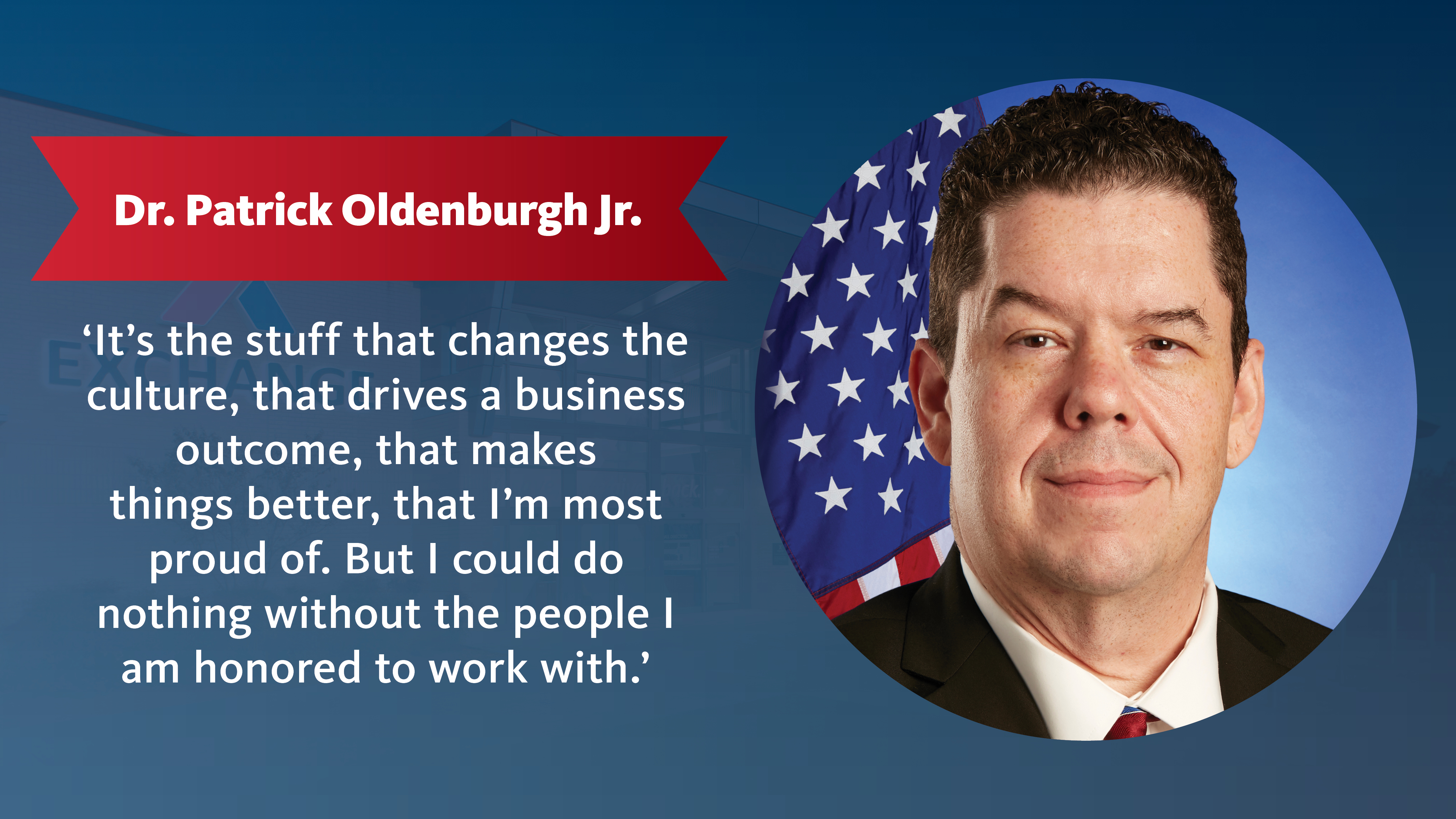
“It’s the stuff like that, the enduring stuff, the stuff that sticks, the stuff that changes the culture, that drives a business outcome, that makes things better, that I’m most proud of. But I could do nothing without the people I am honored to work with.”
Retirement plans
Oldenburgh will officially retire July 25. He plans to move to the Orlando area by December.
“Anything else that I do is going to be a passion project,” he said. “I have a couple of side hustles that I can do from anywhere. If I’m sitting on the lido deck of a cruise ship, I’m sitting on a beach somewhere, it doesn’t matter.”
He also likes taking cruises to see different parts of the world and see different cultures.
“I watch a lot of influencers on YouTube who do a lot of cruising,” he said. “I’m fascinated with them, especially the ones who live on a cruise ship full time. That to me is amazing.”



Share your thoughts!