

In brief:
- The Panama Canal Treaty took effect Oct. 1, 1979
- A day later, the Exchange opened Albrook Mall in Panama City
- The mall consolidated more than 25 Exchange activities
On Oct. 1, 1979, the Panama Canal Treaty went into effect. The treaty stated that the Panama Canal Zone would cease to exist on Oct. 1, 1979, and the canal itself would be turned over to the Panamanians on Dec. 31, 1999.
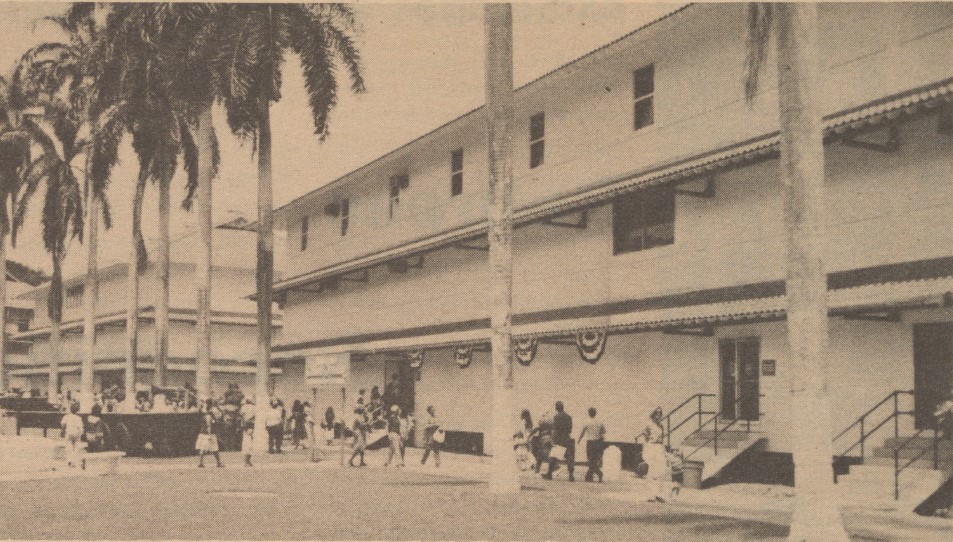
The day after the treaty went into effect, the Exchange officially opened Albrook Mall at Albrook AFB in Panama City. The timing wasn’t a coincidence.
The Panama Canal Treaty was one of two related treaties signed on Sept. 7, 1977. The other one, known as the “Neutrality Treaty,” stated that the United States could use its military to defend the Panama Canal against any threat to its neutrality, thus allowing perpetual U.S. usage of the canal.
Both treaties had a big effect on activities in the Panama Canal Zone, including the Exchange, which had been in Panama since the early 20th century. A planned shift in military sites required the Exchange to find new facilities for more than 25 scattered retail and personal service activities. In addition to serving the military community, the new facilities would serve more than 3,000 Panama Canal Commission employees.
In mid-November 1978, the Exchange began searching for a home for the new facilities. Among the few possible alternatives was a site on Albrook that consisted of four spacious three-story permanent barracks built in the 1930s.
The barracks weren’t in good shape, but it was quickly determined that remodeling them would be less expensive and time-consuming than building a new facility. By mid-June 1979, construction had begun. In less than five months, the drab barracks were converted into brightly colored, attractive shops and showrooms.
On Oct. 2, the 79th United States Army Band provided music as the community gathered and dignitaries arrived for the grand-opening ceremony. Among the VIPs was Maj. Gen. Robert B. Tanguy, deputy commander in chief of the U.S, Southern Command, who praised the project and quipped that he was considering giving “these AAFES folks” some of his military projects because they worked so well.
The Exchange remained active in Panama until the U.S. withdrew in 1999. Most notable was the Exchange’s 1989 support of Operation Just Cause, in which 24,000 American troops invaded the Central American country to oust Panamanian dictator Manuel Noriega from power after he threatened to attack American military installations in the country. In addition to support from the Panama-based Exchanges, CONUS associates deployed and CONUS Exchanges sent extra merchandise to serve the troops.
When the Exchange left Panama in 1999, it ended an 88-year presence. But even as the Panama Exchange drew toward closure, it supported U.S. troops deployed to El Salvador, Honduras, Guatemala and Nicaragua after Hurricane Mitch struck Central America in late 1998. AAFES Panama supplied four tactical field Exchanges and a stationary operation to provide Quality-of-Life support to the troops.
The Exchange still operates a Central American store at Soto Cano Air Base in Honduras.
Sources: Exchange Post archives; Office of the Historian, U.S. Department of State

Share your thoughts!