
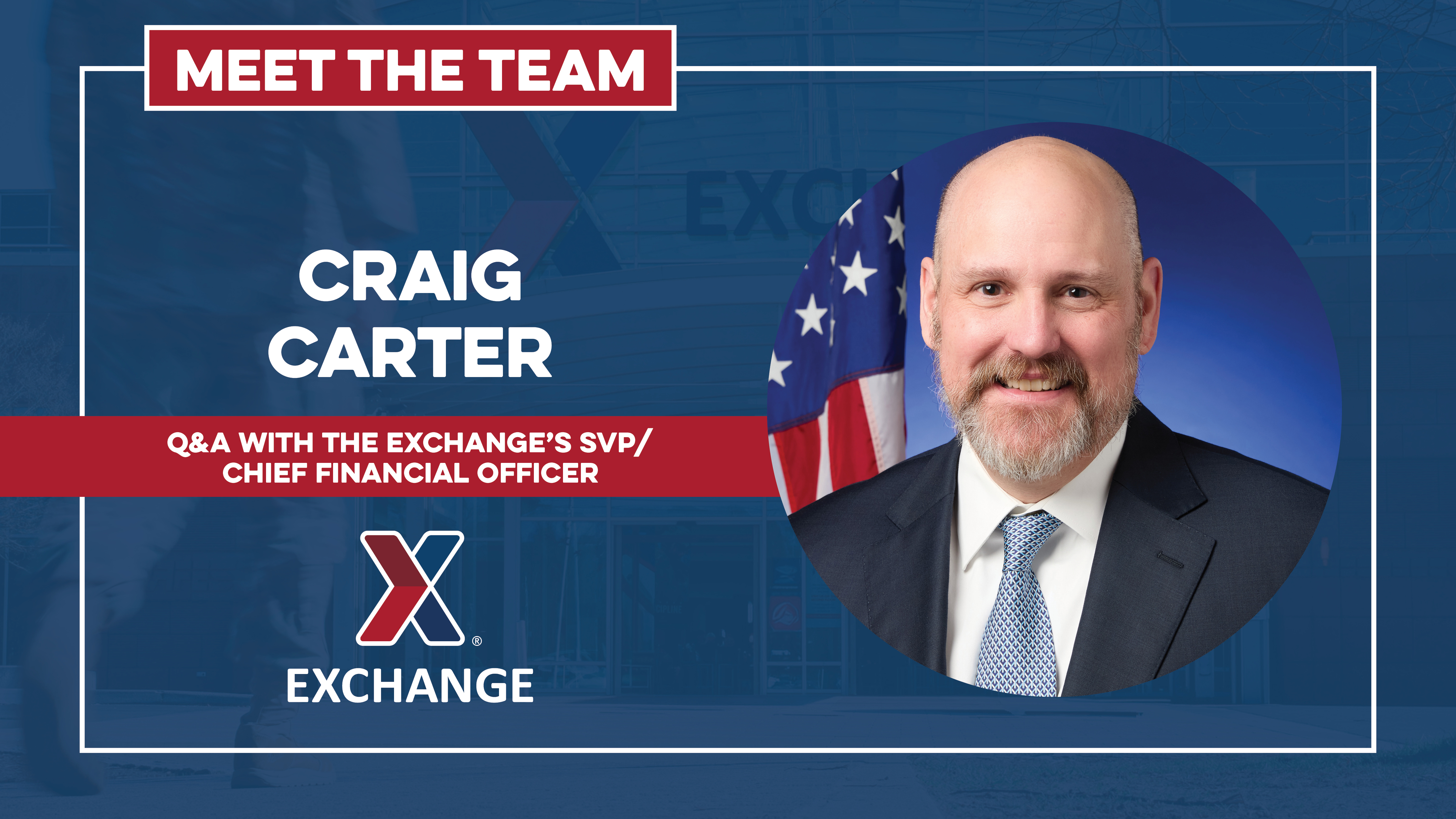

Craig Carter was born on a military installation—Langley Air Force Base—and his father was a Vietnam War Veteran who operated a tank and served in psychological operations during the war.
But Carter’s father left the Army when Carter was young, and his military childhood memories are a bit hazy.
“I lived in Fort Monroe, then Fort Knox and then Fort Hood,” said Carter, who was named Exchange SVP/Chief Financial Officer in June. “But I was maybe 2 to 5 years old during that period. So I have very little memory of that.”
Then his father came to College Station, the home of Texas A&M University, and became an ROTC instructor. Carter would go on to attend A&M himself, earning a bachelor’s degree in political science.
“So I have that history with my dad, and I always go back to him, looking for advice and seeking better understanding of what kind of impact the Exchange’s business has on active-duty Soldiers,” Carter said. “But I only have vague memories of going to the Exchange growing up. Mainly of going to the barber shop, but I have some vague memories of the PX as a child.”
As an adult, though, Carter has been with the Exchange nearly 20 years. Feeling unfulfilled by a civilian job in the mortgage finance industry and sensing the downturn that would come in 2008, he responded to an Exchange ad and came aboard in 2008 as a financial analyst at Exchange headquarters. He worked in positions in Finance & Accounting, including vice president of financial planning and analysis, before assuming his current role.
The Exchange Post recently talked with Carter about his career and what’s ahead for FA.
What led to your joining the Exchange?
A person I worked with at my previous job knew somebody who worked here and was getting ready to move to Germany, and knew the Exchange was looking for a new analyst. So they asked if I was interested. I said I was.
At the time, it wasn’t some sort of altruistic thing. It was more like, “I know of the PX, and my dad has a history with it, so this could be a really good career change. It’s a big organization with a great mission, right?” It was something I could feel good about, but it was also about getting out of the mortgage industry and into something else.
What do you hope to bring to the CFO role?
A big piece is just being a good leader, a good manager, setting the tone for Finance & Accounting. Hopefully I’ll be able to do that in the way I interact with people and with anyone we hire.
Being CFO is more than just being chief accounting officer. At the Exchange, the CFO plays a role in strategy, in helping the director/CEO set the way forward and providing analytical support and input on what the strategy should be.
That includes looking at capital expenditures and reviewing the financials to decide where we need to get better from a financial standpoint. We need to demonstrate fiscal responsibility, be disciplined in our spending and set an example for the rest of the organization. I don’t think it’s fair to tell people to cut their budgets if FA doesn’t do anything.
I want to make sure that we maintain our capital expenditures and provide guidance on spending money in the right places, ensuring that we’re spending on good projects.
We also need to invest in our existing facilities to keep them maintained, so we need a robust plan for that.
What big things are happening for FA?
There are a lot of projects in the queue that are really important for the entire enterprise. From a financial planning and analysis perspective, we’ve been using Excel spreadsheets for eons, and we’re examining the possibility of buying an awesome off-the-shelf software to streamline our budget cleaning process. We’ve done a request for proposals, and we’re looking to see if it’s feasible.
A lot of the time I rely on the vice presidents who report directly to me to talk about what kind of changes we need to make. I try to make it collaborative. That’s the way I am. I really want my team to help us steer the ship in the right direction.
You’ve been in FA since you came to the Exchange in 2008. How does what you’ve learned affect your leadership style?
I had 15 years of experience before the Exchange, and I had leadership roles then. And in college, I had leadership roles for extracurricular activities. I already knew what my voice was. And I knew how I wanted to lead and how I wanted to manage. When I came on board, we were very siloed, and I knew that I wasn’t going to continue those practices.
Have you had opportunities to visit associates in the field?
Most of my career has been in planning and analysis, and we just historically haven’t traveled that much. But I’ve been to Korea, when we had a location in Seoul. I’ve been to Fort Bliss and to the Air Force Academy, during due-diligence trips.
I’ve never really just gone out and said I need to go look at a store. But that’s the thing—we need to. I’ve already talked to our financial planning & analysis team and told them, “You need to get out there because you’re supporting a region. You need to get out there and see how an installation operates. Because we can sit here and get feedback, but something about being on location is irreplaceable, so you can make observations yourself and talk to people and really understand what the issues are.” So that is definitely on my agenda for the coming years, to get out more often.
How did you decide on this career path?
After my dad got out of the Army, he went into commercial banking. My brother had started studying for his Master of Business Administration degree and got into investment banking. I was working for a legal services company, and I decided I wanted to do something else.
I was a political science major at Texas A&M, but I didn’t want to go to law school. So I decided to go back to school to get my MBA [at Southern Methodist University in Dallas]. I’d never taken a finance class before—and it was one of those things that when I took my introductory finance class, everything clicked. It was like, “Oh, this all makes sense to me. This is something I want to be doing.”
What were some of your earliest jobs?
When I was in junior high, I had a paper route in Houston, delivering the Houston Chronicle. It was easy money—the only drawback was having to get up early Saturday and Sunday. It was an early education in responsibility and collections. Back in the day, people couldn’t pay for their paper online, so paperboys had to collect the monthly fees for subscriptions. I had this little collection book and had to knock on the doors of customers’ houses to do collections. Getting the papers, folding them up, putting them in the bag, getting on the bike and delivering them, getting up super early on Saturday and Sunday mornings—that was all good experience. You had to be responsible.
I also worked at a dry cleaners. I drove a van around to pick up laundry from a bunch of satellite places and bring it back to the plant for cleaning. And in high school, I worked at a barbecue catering place. I worked as a greenskeeper at a golf course for two summers. And I worked for a personal-injury lawyer for a few years.
What do you do when you’re not working?
I watch a ton of sports. It’s almost embarrassing how much sports I watch. I’m a huge English Premier League fan. I watch a lot of soccer, and I’m a big college football fan. So my fall and spring are very full.
I try to play guitar as much as I can. I’ve been playing guitar for 20 or 30 years. I’m still not that good at it. But I do try to do that in my spare time. I play for my own enjoyment mostly. Pink Floyd’s “Wish You Were Here” was the first song I ever learned. I wanted to learn that song in college, and I was lucky enough that when I was in the Corps of Cadets at Texas A&M, there were two guys in my class who played guitar. So they taught me how to play. And it took off from there.
What does “family serving family” mean to you?
It means you’re always going to be there for the troops. Just like you’re not going to abandon your family members, and you’re going to help your family need or get whatever assistance that they need. You’re going to be there. It’s the whole “We go where you go” ethos.



Share your thoughts!